 INDIA
INDIA
 USA
USA CANADA
How AI Voice Assistants Are Changing Enterprise Customer Support
06/03/2026
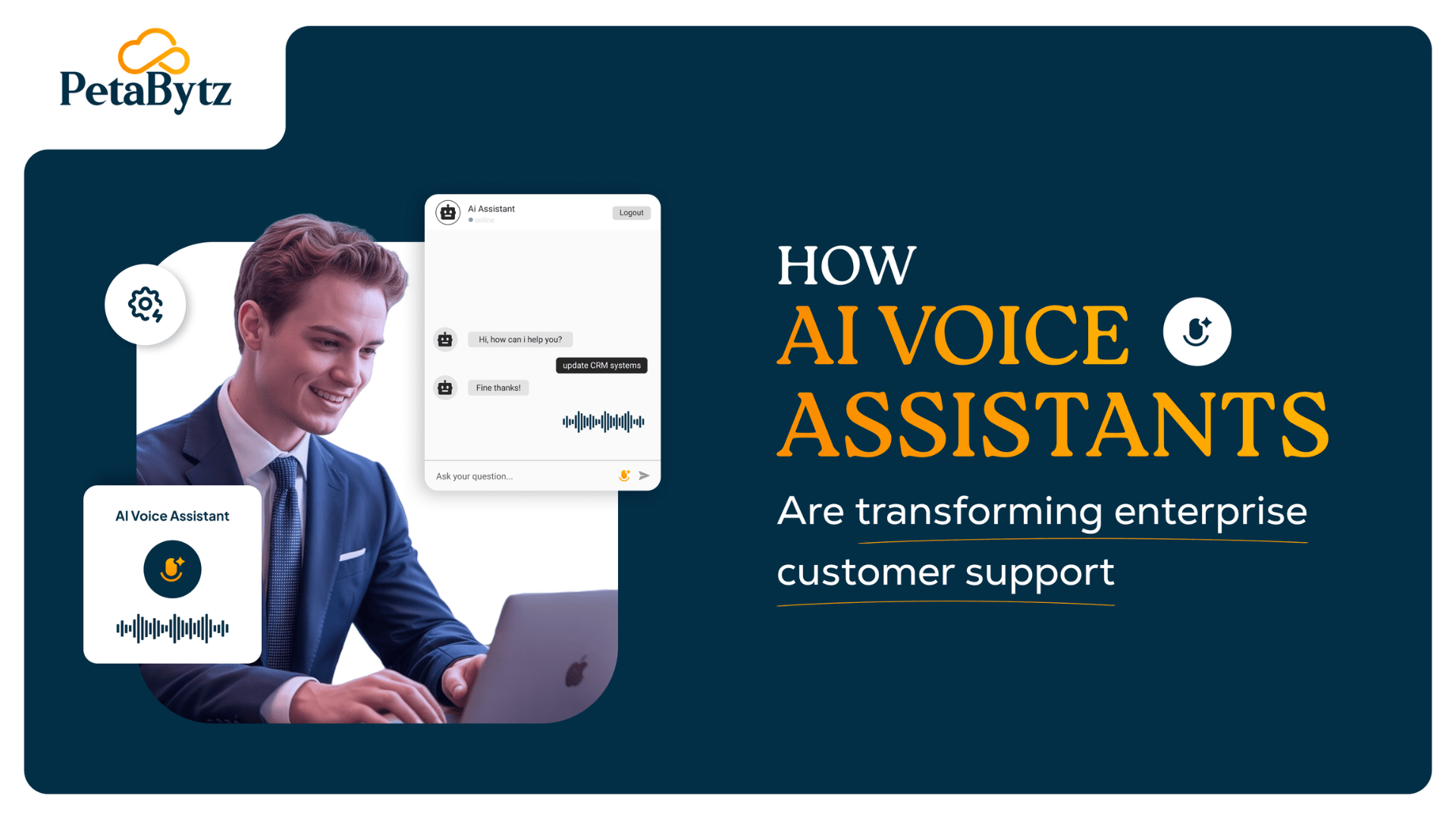
Customer support has changed drastically over the last few years, and the biggest driver behind this shift is the AI voice assistant. Enterprises are no longer relying on traditional IVR systems or overloaded call centers to handle customer queries. Instead, they are turning to intelligent, voice-driven AI solutions that understand context, respond in natural language, and actually make customers feel heard. If your business still runs on old-school support models, it is time to pay attention to what is happening around you.
The numbers tell a clear story. According to Gartner, by 2026, conversational AI will reduce contact center agent labor costs by $80 billion globally. A recent Salesforce report shows that 83% of customers expect immediate engagement when they contact a brand. And studies show that businesses using AI customer service tools have seen up to a 40% reduction in support costs alongside a 35% improvement in first-call resolution rates. These are not just trends. They are signals of a permanent shift in how enterprises handle support at scale.
Contact us now
AI Voice Assistant for Enterprise Customer Support Guide
The Real Problem With Traditional Customer Support
Before we get into what an AI voice assistant can do, it helps to understand why the old model is broken. Customers wait on hold for 10 to 15 minutes just to reach a live agent. IVR menus are confusing, cold, and often loop people around without solving anything. Agents get burned out handling the same repetitive questions all day, which means quality suffers.
- Long wait times frustrate customers and push them toward competitors.
- High call volumes make it nearly impossible to maintain consistent service quality.
- Support agents spend more than 60% of their time on repetitive, low-value queries.
- Scaling a human support team is expensive and slow.
- Traditional systems lack real-time data and insights about customer sentiment.
The result is a customer experience that feels broken and a support team that is constantly stretched thin. This is exactly the gap that conversational AI assistant technology is designed to fill.
What Makes an AI Voice Assistant Different From a Basic AI Chatbot
Many people confuse an AI voice assistant with a simple AI chatbot or a text-based bot that replies to messages. They are not the same thing. A voice-based AI assistant operates in real time over a phone call, understands spoken language, and holds a natural multi-turn conversation. It does not just answer one question and stop. It listens, processes intent, responds intelligently, and follows up based on what the customer says next.
- Understands natural language without requiring scripted inputs from the customer.
- Maintains conversational context across multiple turns in a single call.
- Processes artificial intelligence voice signals to detect emotion, tone, and urgency.
- Works without human intervention for most common support scenarios.
- Learns and improves over time through every call interaction.
Think of it as having a trained, patient, and always available ai assistant on every call, one that never gets tired, never loses its temper, and never puts a customer on hold.
How AI Voice Assistants Are Transforming Enterprise Customer Support
The impact of deploying an AI voice assistant at the enterprise level goes far beyond just answering phone calls faster. It reshapes the entire support operation from the ground up. Here is how enterprises are seeing real transformation.
24/7 Availability Without Extra Staffing Costs
One of the most immediate benefits is round-the-clock availability. Your AI voice assistant does not need breaks, does not call in sick, and handles calls at 2 AM just as effectively as at 2 PM. For enterprises dealing with customers across multiple time zones, this is a game-changer.
Multilingual Support That Builds Customer Trust
For businesses operating in diverse markets like India, language is a major barrier. A powerful AI voice assistant can detect a customer’s preferred language mid-call and switch seamlessly. Whether that is Hindi, Tamil, Marathi, Gujarati, or English, the conversational assistant ai voice generator technology ensures every customer feels spoken to in a language they are comfortable with.
Real-Time Insights With AI Insight Cards
Unlike traditional calls that vanish into thin air, every interaction with your AI voice assistant generates structured data. AI Insight Cards tag each call with intent scores, sentiment analysis, and next-best actions. Your customer service artificial intelligence system does not just handle calls. It helps you understand your customers better with every single conversation.
Instant Follow-Up With SMS Before the Call Even Ends
Speed matters in customer support. With voice AI technology, your system can trigger DLT-registered SMS follow-ups while the call is still in progress. By the time the customer hangs up, they already have the confirmation, reference number, or next steps sitting in their inbox. That kind of proactive service is what turns a one-time caller into a loyal customer.
Agentic AI: The Next Step in Customer Support Automation
The term agentic AI is becoming central to enterprise support conversations. Unlike older automated systems that just respond, agentic AI takes initiative. It can proactively reach out to customers, identify patterns in complaints, escalate issues before they become problems, and suggest resolutions based on historical data.
- Takes action on behalf of the customer without waiting for human approval in pre-defined scenarios.
- Integrates with your CRM, helpdesk, and backend systems to fetch and update data in real time.
- Triggers workflows automatically based on conversation context and customer intent.
- Escalates to a human agent only when truly necessary, with full context already handed over.
This level of automation is what separates a basic AI chatbot from a truly intelligent ai virtual assistant that operates as an extension of your support team.
Why Seamless Integration Is Critical for Enterprise AI Deployment
One of the biggest concerns enterprises have when adopting an AI voice assistant is disruption. Nobody wants to tear apart a working system just to plug in new technology. The good news is that modern artificial intelligence assistant platforms are built to integrate, not replace.
- Connects with existing CRM platforms like Salesforce, Zoho, and HubSpot without any heavy lifting.
- Works with popular helpdesk tools such as Freshdesk, Zendesk, and ServiceNow.
- Syncs with custom internal workflows via API so your current processes stay intact.
- Requires no complete overhaul of existing infrastructure to go live.
At PetaBytz Technologies, our AI voice assistant solution is designed specifically to drop into your existing stack with minimal friction and maximum impact. Whether you run a mid-size business or a large enterprise, we make the transition smooth and measurable.
The Business Impact: What You Actually Gain
When you deploy a well-built AI voice assistant across your support operations, the business outcomes are concrete and measurable. Here is what enterprises typically experience within the first few months.
- Up to 60% reduction in average call handling time per customer.
- 30 to 50% decrease in support operational costs within the first year.
- Significant jump in CSAT scores due to faster, more consistent responses.
- Agents freed from repetitive calls now focus on complex and high-value interactions.
- Better compliance and documentation since every AI interaction is logged and auditable.
Beyond the numbers, there is something less tangible but just as valuable. Your customers start to trust that your support will be fast, consistent, and available whenever they need it. That trust translates directly into retention and revenue.
Ready to Transform Your Customer Support?
At PetaBytz Technologies, we build AI voice assistant solutions that are enterprise-ready, multilingual, and deeply integrated with your existing systems. Whether you want to reduce support costs, improve customer satisfaction, or scale your operations without scaling your team, we have the technology and the expertise to make it happen.
Talk to our team today and see how our AI voice assistant can go live in your business.
Book a Free Demo With PetaBytz Technologies
Contact Us
Website: www.petabytz.com
Email: info@petabytz.com
