INDIA
INDIA
 USA
USA CANADA
RPA vs Agentic AI: Stop Automating Tasks – Start Automating Decisions
07/04/2026
The Automation Illusion: We Moved Fast, But Not Smart
When enterprises first embraced robotics and automation, the promise was simple: move faster, reduce errors, cut costs. Robotic Process Automation delivered on that promise for a while, repetitive tasks got done in seconds, human errors dropped, and operations teams felt like they had finally gained control.
But here is what nobody talks about enough: speed without intelligence is just fast failure. The RPA vs Agentic AI conversation has moved from technology blogs into boardrooms because enterprises are now asking a deeper question. Not “can we automate this task?” but “can we automate the decision behind it?” That shift is what separates automation leaders from the laggards.
The data make this urgency impossible to ignore. According to Gartner, over 80% of RPA deployments require significant human intervention to handle exceptions.Forrester reports that 52% of enterprises have hit scalability walls with their current process automation strategy — a clear sign that yesterday’s tools are no longer enough. And McKinsey estimates that intelligent, decision-driven automation of the kind seen in mature RPA vs Agentic AI strategies, can unlock up to 5.7 trillion in global economic value by 2030
Contact us now
RPA vs Agentic AI: Automate Smarter Desicions
Why RPA Is Hitting a Ceiling – And It Is Not Your Fault
RPA is not a failed technology. It was purpose-built for structured, repeatable, rule-based tasks. Invoice extraction, data entry, report generation — these are RPA’s sweet spot. The problem is not what RPA does. It is what it cannot do. And understanding those structural limits is the first step toward building a smarter RPA vs Agentic AI strategy — one that goes well beyond what a standard rpa implementation alone can achieve.
Today’s enterprise does not operate in predictable straight lines. Customer behaviour shifts overnight. Processes that worked perfectly last quarter break the moment one upstream system updates its data format. Every single time that happens, your bots stop, and a human has to step in.
- Rule-based logic fails in dynamic, unpredictable environments
- No contextual understanding — the bot cannot read between the lines
- High maintenance overhead — constant script updates when processes change
- Zero decision-making capability — every exception is escalated to a human
- Hard scalability ceiling — more complexity means more bots and more cost
RPA is excellent for structured, repetitive tasks — but enterprises are no longer operating in predictable environments. Even the most optimised rpa implementation hits this wall eventually. That is the ceiling RPA cannot break on its own. That is where RPA vs Agentic AI becomes a strategic question.
The Missing Layer: Automation Without Intelligence Is Incomplete
Here is what most automation roadmaps miss: the layer between executing a task and achieving an outcome. That layer is decision intelligence — the ability to understand context, assess conditions, and choose the right path forward in real time.
Your organisation does not need more bots. It needs systems that can think. Systems that understand why a task is happening, not just what needs to happen next. The limits of process automation as it exists today make this gap impossible to ignore. This is exactly where the RPA vs Agentic AI distinction stops being theoretical and becomes operational. Agentic AI enters not as an upgrade to your existing automation layer, but as a fundamental architectural shift.
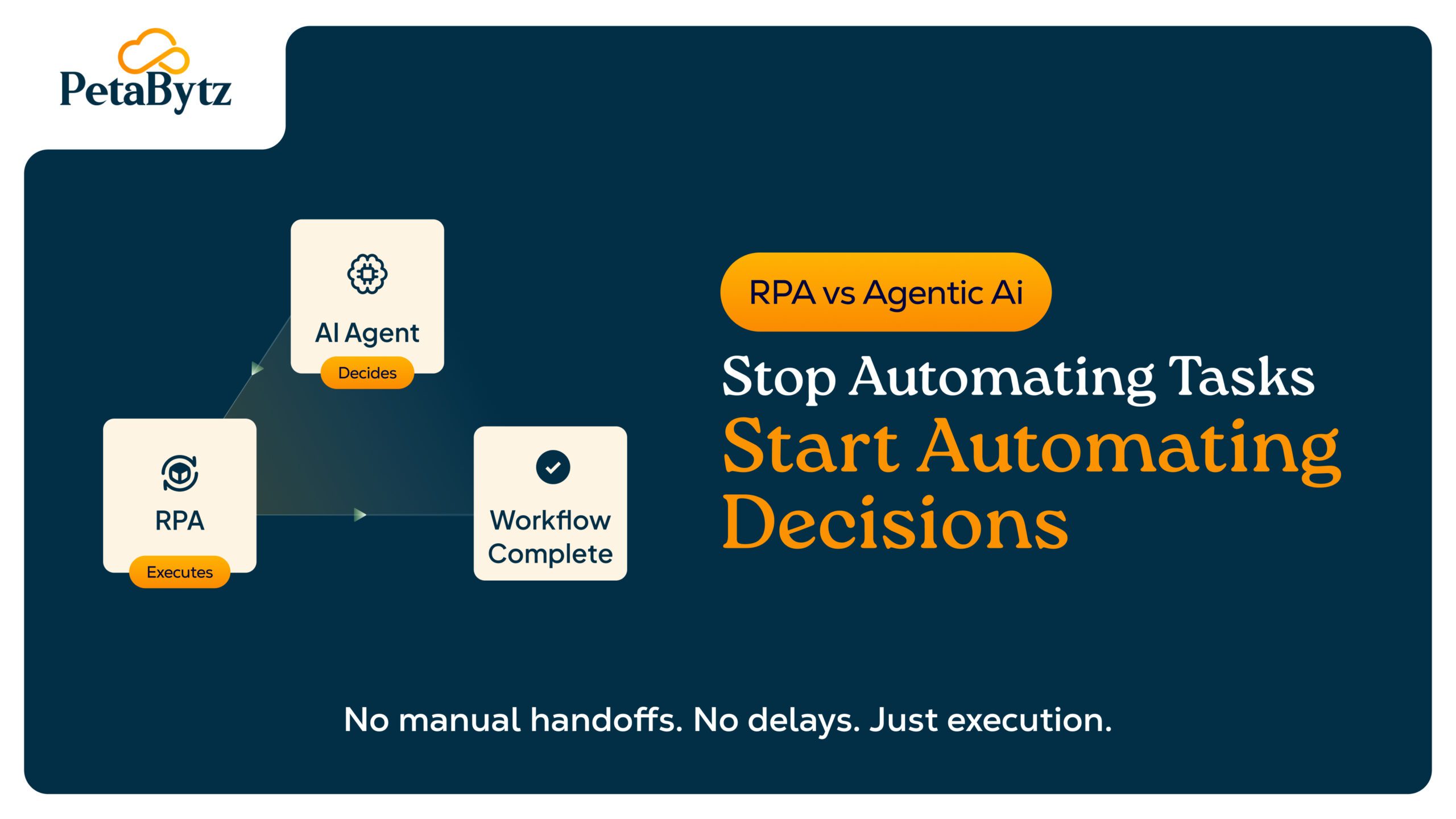
RPA automates tasks. Agentic AI automates the decisions that govern those tasks. In the RPA vs Agentic AI framework, this is a fundamentally different value proposition — and a far more powerful one.
What Is Agentic AI? From Task Execution to Goal-Driven Systems
Agentic AI refers to AI systems that operate with genuine autonomy toward defined goals. Unlike traditional RPA or hybrid models that simply layer basic ML on top of bots — Agentic AI works with a purpose-driven architecture that continuously plans, executes, monitors, and adapts.
An AI agent does not wait to be told what to do next. It sets a goal, plans the steps to achieve it, executes actions, monitors outcomes, and adjusts its approach based on what it learns. Think of it as the difference between handing someone a checklist and hiring someone who deeply understands the objective.
The clearest way to frame the RPA vs Agentic AI distinction in one sentence:
RPA says: “Do this task.” | Agentic AI says: “Achieve this outcome.” — That sentence captures the entire evolution of enterprise automation. One is instruction-following. The other is goal-achieving. And for the RPA vs Agentic AI evaluation, that difference is everything.
RPA vs Agentic AI: Key Differences That Actually Matter
When evaluating RPA vs Agentic AI for your organisation, you need to look beyond surface-level feature comparisons. Here is what the differences look like across the dimensions that genuinely drive enterprise outcomes:
- Logic Type
RPA operates on rigid, predefined rules. Agentic AI operates on goals — it reasons about what needs to happen, not just what the script says to do next. - Flexibility
RPA is low flexibility by design. Agentic AI is highly adaptive, adjusting its approach based on context, conditions, and outcomes. - Decision-Making
RPA has none. Agentic AI is built around contextual, real-time decision-making — the defining capability in any honest RPA vs Agentic AI comparison. - Exception Handling
RPA escalates every exception to a human. Agentic AI resolves most exceptions autonomously, learning from each one. - Maintenance Overhead
RPA demands constant script updates every time a process changes. Agentic AI is self-adapting, dramatically reducing the maintenance burden over time.
In the RPA vs Agentic AI comparison, RPA executes while Agentic AI thinks. Both have a role — but only one scales with the full complexity of modern enterprise operations.
Real Enterprise Problems That Demand More Than Bots
Let us get practical. Here are three scenarios where the limits of traditional RPA become painful — and where a well-designed RPA vs Agentic AI strategy delivers measurable impact:
- Customer Support
RPA routes tickets by keyword match. Agentic AI understands customer intent and resolves queries end-to-end, without human handoff. - IT Service Management
RPA creates tickets and logs incidents. Agentic AI diagnoses root cause and triggers the fix automatically, reducing mean time to resolution dramatically. - Finance Operations
A typical rpa implementation in finance processes invoices and matches line items efficiently. Agentic AI goes further — detecting anomalies, flagging potential fraud, and approving transactions within defined policy, all in real time.
In every scenario above, the bottleneck is not the task — it is the decision embedded inside the task. That is the gap the RPA vs Agentic AI evolution was built to close. And that gap is costing organisations more every quarter they delay addressing it.
The Shift Already Happening: From Automation to Autonomy
Enterprises winning today are not just investing in robotics and automation — they are redesigning the entire model. Moving from static workflows to dynamic systems. From human-in-the-loop to AI-in-the-loop. From chasing efficiency to driving intelligent outcomes at scale.
The RPA vs Agentic AI distinction is not merely a technology trend. It is a strategic one. Organisations that understand this difference clearly today are building competitive advantages that will compound over the next five years. Those that do not will continue patching bot failures and wondering why their automation ROI has plateaued.
The future of enterprise automation is not about doing more tasks faster, it is about making smarter decisions at scale. That is the core promise of Agentic AI in any mature RPA vs Agentic AI roadmap.
The Smart Approach: RPA and Agentic AI Working Together
Here is an important clarification for organisations with significant existing RPA investments. When we talk about RPA vs Agentic AI, it is not an either-or choice. Agentic AI does not replace RPA. It completes it.
Think of it as a two-layer architecture. RPA handles the execution layer: form filling, data entry, system-to-system transfers, report generation, and compliance data collection. Agentic AI handles the intelligence layer above it: exception handling, context-aware recommendations, dynamic workflow orchestration, and goal-driven process optimisation.
The RPA vs Agentic AI hybrid model is not a compromise; it is the most pragmatic path for enterprises that want to modernise without discarding what already works. You protect your existing automation investment while layering in the intelligence needed to truly scale.
What Changes When You Automate Decisions: Business Impact
When organisations make the shift from task automation to decision automation, which is the defining outcome of a mature RPA vs Agentic AI strategy — the impact extends well beyond operational metrics. Here is what becomes possible:
- Faster decisions — time-sensitive workflows resolve in seconds, not hours
- Reduced operational risk — fewer human errors in high-stakes processes
- Scalable automation — systems that grow with complexity rather than against it
- Improved customer experience — faster, more accurate, personalised responses
- Strategic bandwidth — your people focus on work that genuinely needs human creativity
- Lower total cost of automation — less maintenance, fewer exception-handling hours
Challenges Worth Respecting: What Enterprises Must Get Right
A balanced RPA vs Agentic AI perspective requires acknowledging real challenges. Agentic AI is powerful, but it is not a plug-and-play solution. Getting the most from intelligent automation at this level requires readiness across four critical areas:
- Governance and control — clear guardrails around what AI agents can and cannot decide autonomously
- Data quality — agents are only as smart as the data they reason over
- AI alignment — ensuring agent goals remain aligned with actual business objectives
- Change management — teams need to trust and understand how the AI is making decisions
Practical Roadmap: How to Move From Bots to Intelligent Systems
If you are ready to evolve your automation architecture, here is a clear, enterprise-tested path for executing your RPA vs Agentic AI transition:
- Identify decision-heavy workflows — map processes where exceptions and changing conditions create recurring bottlenecks
- Audit existing RPA performance — find failure points and processes that consistently require human override
- Introduce Agentic AI in layers — begin with a high-impact, contained use case before expanding
- Build a governance framework — define decision boundaries, escalation rules, and monitoring protocols before scaling
- Scale with feedback loops — let agent performance data guide your RPA vs Agentic AI expansion plan
The Real Future of Automation: Decide Smarter, Not Just Faster
If you take one thing away from this blog, make it this: the most powerful automation an enterprise can build is not the kind that moves tasks faster, it is the kind that makes decisions smarter.
The RPA vs Agentic AI conversation is not about abandoning what works. It is about recognising where the real value lives, in the decisions that drive your processes, not in the processes themselves. Enterprises that see this clearly will be the ones who lead their industries over the next decade.
At PetaBytz Technologies Inc., we help organisations design and implement intelligent automation strategies that go beyond bots. Whether you are optimising an existing RPA deployment or building a decision-first Agentic AI architecture from scratch, we bring the technical depth and enterprise experience to get it right.
Is Your Automation Strategy Ready for This Shift?
Connect with the PetaBytz Technologies Inc. team to explore how RPA vs Agentic AI decision-driven automation can transform your enterprise operations without disrupting what already works.
Start building decision-first systems today:
Website: www.petabytz.com
Email: info@petabytz.com
Frequently Asked Questions (FAQ’s)
1. What is the main difference between RPA and Agentic AI?
The core RPA vs Agentic AI difference comes down to task execution versus autonomous decision-making. RPA follows predefined rules to handle structured, repetitive tasks. Agentic AI operates with genuine autonomy, it understands goals, makes contextual decisions in real time, and adapts its approach based on outcomes. In any honest RPA vs Agentic AI evaluation, decision-making capability is the defining differentiator.
2. Can RPA and Agentic AI work together in the same enterprise environment?
Yes — and this is the recommended approach for most enterprises. In a well-designed RPA vs Agentic AI architecture, RPA handles the structured execution layer while Agentic AI manages the decision and intelligence layer above it. A hybrid model protects existing investments while enabling intelligent, scalable expansion.
3. Is Agentic AI ready for enterprise-scale deployment?
Agentic AI is actively deployed in production environments across finance, IT, healthcare, and customer operations. A successful RPA vs Agentic AI transition requires proper governance, data readiness, and a phased rollout strategy. The technology is mature — the question is whether your organisation is prepared to adopt it responsibly.
4. How do I know if my organisation needs Agentic AI or just better RPA?
If your bots frequently hit exceptions, require human overrides, or fail when upstream systems change — you have likely outgrown pure RPA. When the bottleneck is the decision behind the task rather than the task itself, that is precisely when the RPA vs Agentic AI question becomes a strategic priority worth solving seriously.
Recent Posts