INDIA
INDIA
 USA
USA CANADA
Enterprise IT Teams Are Drowning in Dashboards But Starving for Operational Clarity
20/05/2026
Your engineer gets a ticket. A frustrated employee says their laptop is slow and they cannot access company apps. Simple enough, right?
Except your engineer now has to open six different tools just to start investigating. The endpoint dashboard. The identity logs. The Microsoft 365 admin panel. The VPN console. The AWS monitoring screen. The SIEM platform.
That is the reality of enterprise IT in 2024. More than 76% of large organizations run five or more monitoring tools simultaneously. Yet most enterprise IT teams still cannot see their entire environment in one place.
This fragmentation is not just annoying. It is costing your business real money. Studies show that IT teams spend up to 40% of their incident response time just switching between tools and manually correlating data.
In this guide, you will learn:
- Why enterprise IT visibility breaks down across platforms
- How tool fragmentation silently inflates your MTTR
- Why alerts without context are worse than no alerts at all
- What unified observability looks like in practice
- How modern ITSM solutions solve the cross-platform chaos
- Practical best practices your enterprise IT team can apply today
Contact us now
Enterprise IT and Cross-Platform Visibility Gaps
Why enterprise IT environments became so complex
Ten years ago, a typical enterprise IT stack was manageable. Today, it is a sprawling ecosystem of cloud platforms, SaaS tools, endpoint agents, and security layers.
Here is what a standard large enterprise runs simultaneously:
- Microsoft 365 for productivity and identity management
- Amazon Web Services for cloud infrastructure
- ServiceNow for IT service management and ticketing
- CrowdStrike, Microsoft Intune, or SentinelOne for endpoint security
- Splunk or Microsoft Sentinel as SIEM and security monitoring platforms
Each of these tools is powerful on its own. But none of them were designed to talk to each other out of the box. The result? Enterprise IT teams operate in a state of permanent information overload with zero unified clarity.
The core visibility problem facing enterprise IT today
When something breaks, the pain starts immediately. Your enterprise IT team cannot see the full picture from a single place.
Consider a real-world scenario. An employee reports their laptop is slow and they cannot log into company applications. Here are all the possible causes your team needs to investigate:
- Endpoint device hardware or software issue
- Identity or authentication failure in Azure AD
- Microsoft 365 access restriction or service outage
- VPN configuration failure or network routing problem
- AWS backend latency or service degradation
- Security policy blocking access due to a compliance flag
- Expired license or permission in the ITSM system
The data for each of these causes lives in a different platform. Your engineers waste valuable time doing the following:
- Switching between six or more dashboards
- Manually correlating logs with different timestamps and formats
- Pinging multiple teams to cross-reference findings
- Repeating diagnostics because context gets lost in handoffs
According to IBM, the average cost of a critical IT incident is $5,600 per minute for enterprise organizations. Every extra minute your enterprise IT team spends chasing data across disconnected tools is money leaving the business.
Three root causes of cross-platform visibility failure
1. Tool fragmentation across departments
Every business unit buys tools that solve their specific problem. Security buys a SIEM. IT support implements an ITSM platform. The cloud team spins up AWS monitoring dashboards. The endpoint team deploys device management agents.
None of these teams coordinate on data integration. The result is a fragmented enterprise IT stack where no tool has the full picture.
- Security tools track threats but not business impact
- ITSM tools track tickets but not infrastructure health
- Cloud tools track performance but not user experience
- Endpoint tools track device status but not application behavior
2. No unified data layer
Each platform stores and identifies the same user or asset differently. This makes manual correlation painful and error-prone.
A single employee might appear as:
- An email address in Microsoft 365
- A device ID in Microsoft Intune
- A username or ARN in AWS
- A ticket number in your ServiceNow ITSM platform
Connecting those four identifiers manually requires time, expertise, and context that most enterprise IT engineers simply do not have during an active incident.
3. Too many alerts, zero context
Large enterprise IT environments generate thousands of alerts every single day. Tools are configured to catch every anomaly, which sounds good in theory.
In practice, it creates alert fatigue. Research from Forrester shows that 27% of security and IT alerts are never investigated because teams are simply overwhelmed.
- Security tools fire alerts without knowing if a service is business-critical
- Monitoring tools flag performance drops without knowing if anyone is affected
- ITSM platforms receive hundreds of tickets without knowing the shared root cause
Your enterprise IT team sees the individual alerts. But they cannot see the story connecting those alerts. That is the real visibility gap.
A real-world enterprise IT incident without unified visibility
Here is how a common enterprise IT incident unfolds when your tools are siloed.
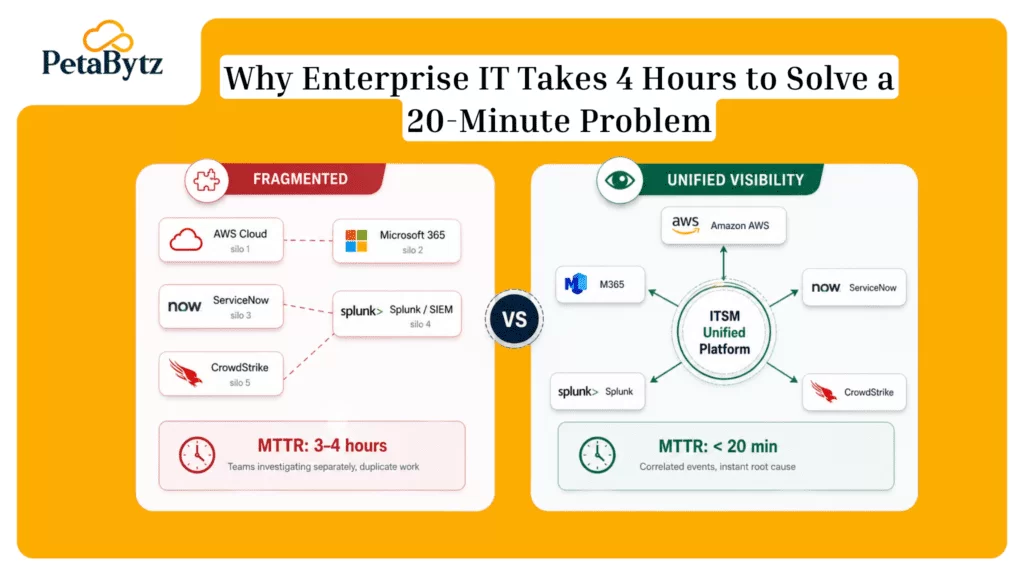
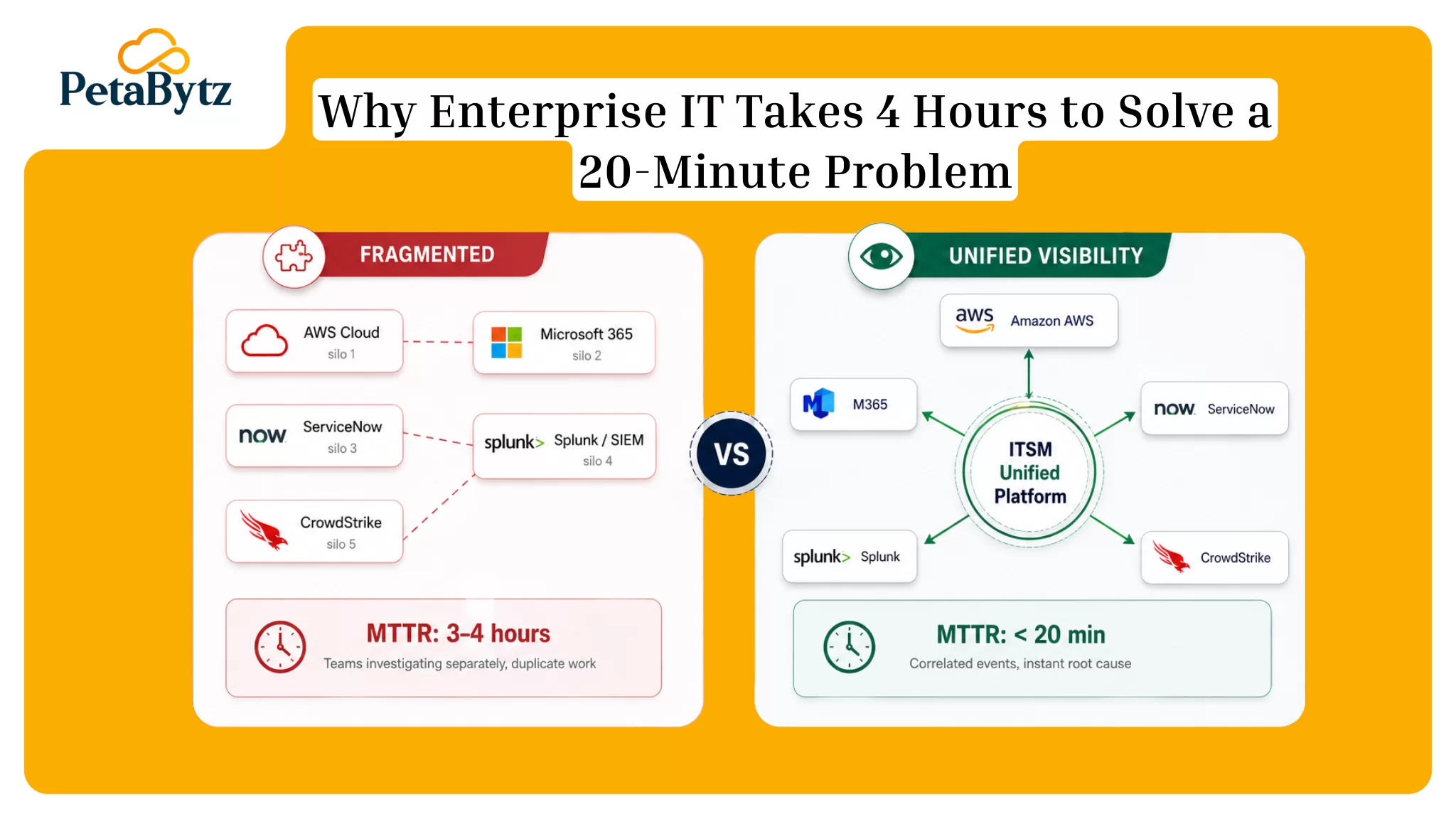
AWS server latency increases at 9:14 AM. Employees in three offices start experiencing Microsoft 365 login delays at 9:17 AM. The security SIEM flags unusual authentication patterns at 9:19 AM. By 9:25 AM, your ServiceNow ITSM queue has 200 new tickets.
Without cross-platform visibility, here is what happens:
- The cloud team investigates AWS assuming a configuration issue
- The identity team investigates Azure AD assuming a breach attempt
- The helpdesk team works through 200 individual tickets one by one
- Each team duplicates effort because they cannot see what the others found
Mean time to resolution stretches from 20 minutes to 3 or 4 hours. The root cause was AWS latency. It was discoverable in under 5 minutes with correlated data.
With unified enterprise IT visibility, here is the difference:
- Correlated events surface AWS latency as the probable root cause automatically
- The on-call engineer sees one consolidated alert instead of 200 tickets
- Resolution begins within minutes, not hours
- MTTR drops by up to 60%, according to industry benchmarks
Workflow templates for enterprise IT cross-platform visibility
1: Cross-platform incident correlation
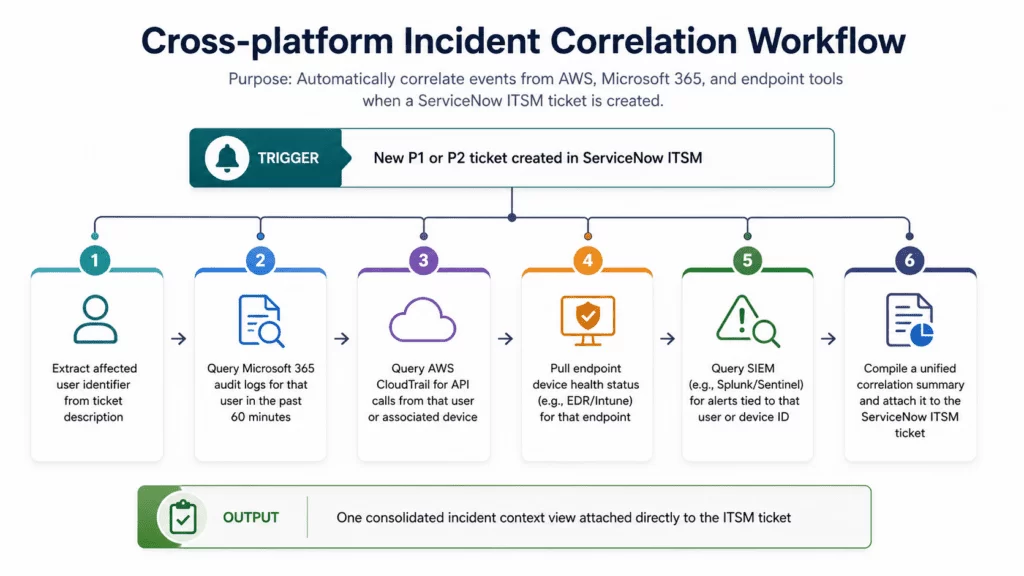
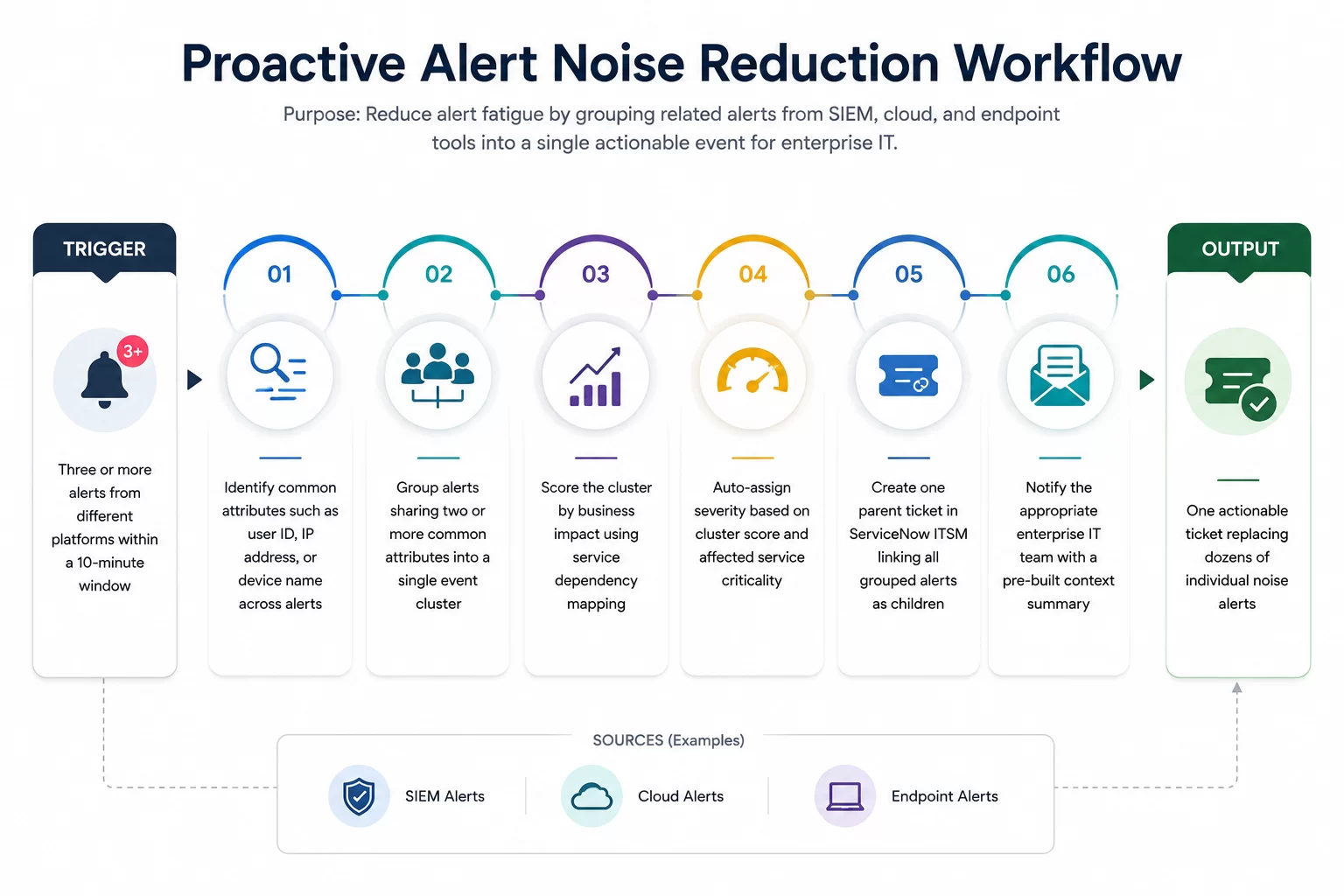
2: Proactive alert noise reduction workflow
Suggested Reading:
Transform Workforce Quality With a Skills Based Hiring StrategyBest practices to improve enterprise IT cross-platform visibility
- Build a single source of truth for user and asset identity. Map every user across all platforms using a common identifier such as employee ID or UPN.
When your enterprise IT team investigates an incident, they should be able to pull all related data with one lookup. This single mapping cuts manual correlation time by up to 70%. - Integrate your ITSM platform with observability tools. ServiceNow ITSM should not exist in isolation. Connect it to your SIEM, cloud monitoring, and endpoint management platforms via APIs or native integrations.
When a ticket opens, relevant telemetry should automatically attach to that ticket. Your enterprise IT team should never have to leave the ITSM interface to get full context. - Define alert severity tiers based on business impact. Not every alert from your SIEM or monitoring tool deserves immediate attention.
Build a tiering framework that factors in business criticality, number of affected users, and service dependency. This helps your enterprise IT team focus on what actually matters instead of chasing noise. - Run cross-platform incident drills quarterly. Most enterprise IT teams only discover visibility gaps during real incidents. Schedule quarterly tabletop exercises that simulate multi-platform failures.
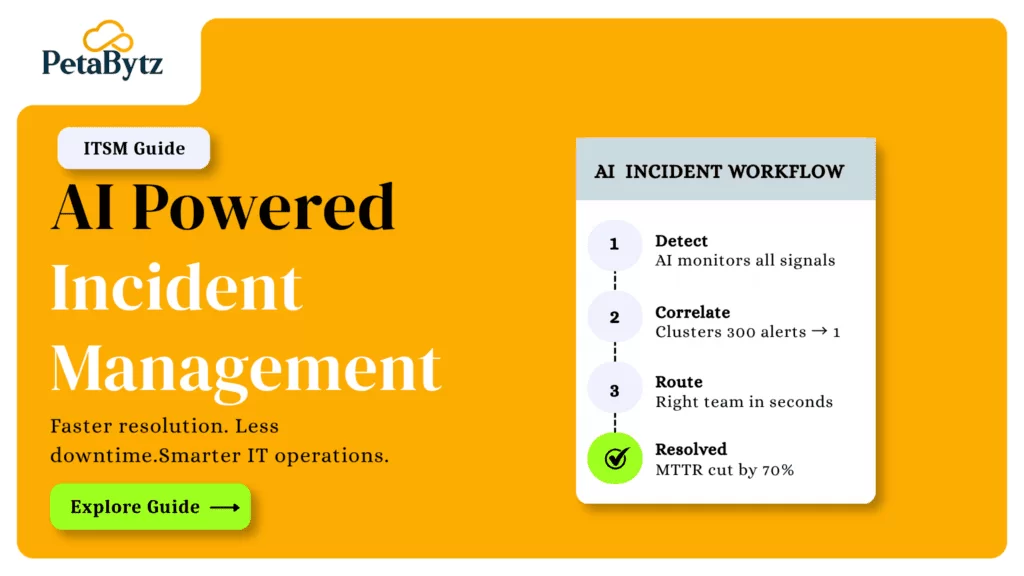
This reveals where your data flows break down and where manual steps slow your team down before it happens under production pressure. - Adopt AI-assisted event correlation for your enterprise IT team. Modern ITSM solutions and observability platforms offer AI correlation engines that automatically group related alerts, identify probable root causes, and suppress duplicate noise.
Teams using AI-driven correlation report up to 50% fewer escalations and significantly faster MTTR. This is not a future capability. It is available now. - Document your cross-platform runbooks and keep them current. Every time your enterprise IT team resolves a multi-platform incident, capture the steps in a runbook.
Include which tools were queried, what data was correlated, and how the root cause was identified. Reusable runbooks reduce investigation time on repeat incident types by 35% on average.
How ITSM solutions solve the enterprise IT visibility challenge
The root cause of cross-platform blindness is not a people problem. Your enterprise IT engineers are skilled. The problem is that the tools they use were never designed to share context with each other automatically.
That is exactly what modern ITSM solutions address. A well-implemented ITSM platform does not just manage tickets. It becomes the operational intelligence layer sitting above all your other tools.
Here is what connected ITSM looks like in practice for enterprise IT:
- Alerts from Splunk, Sentinel, and CrowdStrike flow directly into the ITSM platform with full context
- AWS health events and Microsoft 365 service degradations trigger correlated ITSM incidents automatically
- ServiceNow ITSM links affected users, devices, and services into one unified incident record
- AI correlation engines surface probable root causes before human investigation begins
- Resolution workflows route to the right team automatically based on the incident type
Petabytz helps enterprise IT teams implement exactly this kind of connected, intelligent IT service management. Rather than dropping another siloed tool into your stack, Petabytz focuses on integrating what you already have, closing the visibility gaps, and giving your enterprise IT team the operational clarity they need to resolve incidents faster.
If your enterprise IT environment runs Microsoft 365, AWS, ServiceNow, and security tools that never quite talk to each other, a structured ITSM integration approach can fundamentally change how your team operates.
Conclusion
You do not need to rip out your existing enterprise IT tools to solve the visibility problem. The platforms you already have contain the data your team needs.
The real challenge is connecting that data into a coherent picture that your enterprise IT team can act on without wasting hours switching between dashboards.
Unified observability, AI-powered correlation, and a well-integrated ITSM solution are not luxury upgrades. For enterprises running hybrid cloud environments with remote workforces, they are operational necessities.
Your enterprise IT team is capable. Give them the visibility they deserve.
Ready to close your cross-platform visibility gaps? Petabytz works with enterprise IT teams to design and implement connected ITSM environments that deliver real operational clarity. Reach out to start the conversation.
Website: www.petabytz.com
Email: info@petabytz.com
Ready to move faster than your competitors? Talk to Petabytz today
Contact UsFrequently Asked Questions (FAQ’s)
What does cross-platform visibility mean for enterprise IT?
Cross-platform visibility means your enterprise IT team can view correlated data from all tools, including cloud, endpoint, identity, and ITSM platforms, in one unified view without switching between separate dashboards manually.
Why do enterprise IT teams struggle with MTTR in complex environments?
High MTTR in enterprise IT environments is typically caused by tool fragmentation. When incident data is spread across SIEM, ITSM, cloud monitoring, and endpoint tools, engineers spend most of their time correlating data rather than resolving the actual issue.
How does ServiceNow ITSM help with enterprise IT visibility?
ServiceNow ITSM can serve as a central operational intelligence layer for enterprise IT. When integrated with cloud, security, and endpoint tools, it automatically consolidates alerts, links related events, and gives engineers full incident context in a single interface.
What are the best ITSM solutions for large enterprise IT environments?
The best ITSM solutions for enterprise IT are those that integrate natively with your existing stack. ServiceNow ITSM, combined with AI-powered event correlation and connections to Microsoft 365, AWS, and security platforms, remains the industry-leading choice for large organizations.
Can AI reduce alert fatigue in enterprise IT operations?
Yes. AI-assisted correlation in modern enterprise IT platforms can group thousands of daily alerts into a handful of actionable incidents. Enterprise IT teams using AI correlation report up to 50% fewer escalations and significantly lower MTTR across their environments.
Recent Posts