INDIA
INDIA
 USA
USA CANADA
How Multi Agent Systems Work And Why They Are Replacing Single-Model AI
01/04/2026
You have probably noticed that AI is no longer just a chatbot answering questions. It is planning, executing, reviewing, and iterating, all on its own. And the engine behind this shift? Multi Agent Systems.
According to a 2024 McKinsey report, over 65% of enterprises are either piloting or actively deploying AI agents in their operations. A separate Gartner forecast predicts that by 2028, at least 33% of enterprise software applications will include some form of agentic AI, up from less than 1% in 2024. These numbers tell a clear story: the era of single-model AI is giving way to something far more powerful and capable.
Contact us now
Multi Agent System: How they Work & Why they Win?
Why Single-Model AI Is Hitting a Wall
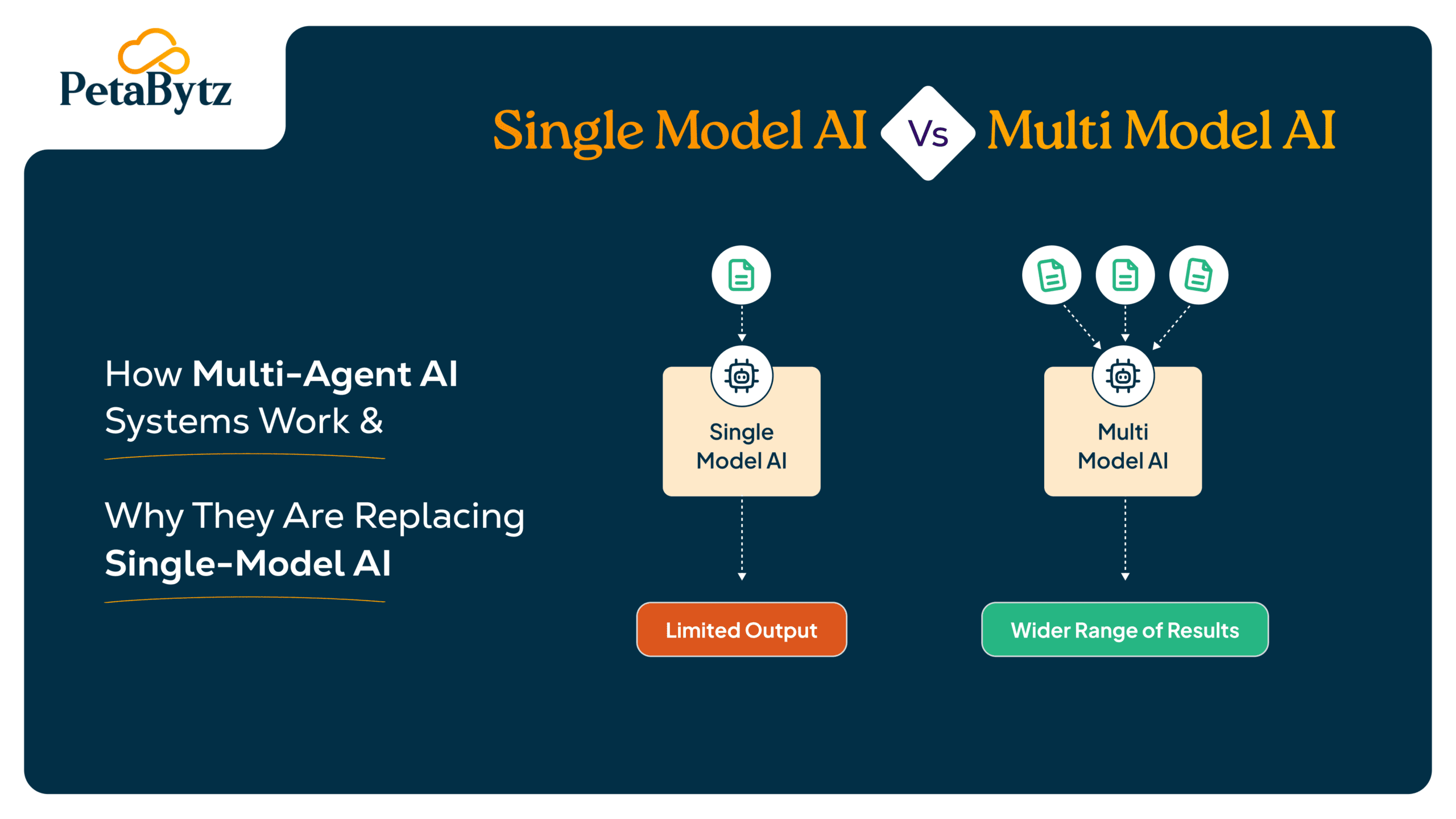
Think of a single AI model like a brilliant solo professional. They are smart, fast, and reliable, but ask them to simultaneously research a topic, write a report, review legal compliance, run financial calculations, and manage customer queries, and they will quickly reach their limits.
Single models struggle with:
- Context window overflow on long, complex tasks
- Lack of specialization across different domains
- No ability to self-verify or catch their own errors
- Sequential processing that slows down multi-step workflows
This is exactly the problem that Multi Agent Systems solve. Instead of overloading one model, they distribute the work across a coordinated team of specialized agents, each focused on what it does best.
What Exactly Are Multi Agent Systems?
Multi Agent Systems are architectures where multiple AI agents work together, each with a defined role, to solve problems that are too complex or too broad for a single model to handle efficiently.
Think of it like a well-run company. You have a project manager who delegates tasks, a researcher who gathers data, a writer who creates content, a reviewer who checks quality, and a compliance officer who makes sure everything is on track. None of them does everything, but together they deliver results that no individual could match.
In technical terms, each agent in a multi agent setup has:
- Its own set of tools and permissions
- A specific area of expertise or responsibility
- The ability to communicate and share context with other agents
- An independent reasoning loop that feeds into the broader system
How Does Multi Agent Orchestration Actually Work?
The backbone of any effective Multi Agent AI System is multi agent orchestration. Orchestration is the coordination layer that decides which agent handles which task, in what order, and how information flows between them.
Here is a simplified flow of how orchestration typically works:
- User Input or Trigger arrives at the system
- The Orchestrator Agent breaks down the goal into subtasks
- Subtasks are assigned to specialized agents based on their capabilities
- Agents work in parallel or sequence, passing outputs to each other
- A reviewer or validation agent checks for accuracy and consistency
- The final output is compiled and returned
This structured collaboration, driven by smart multi agent orchestration, is what allows businesses to run complex, multi-step AI workflows at scale without human bottlenecks.
Multi Agent Planning in Artificial Intelligence: The Brain Behind the System
One of the most fascinating aspects of Multi Agent Systems is how they plan. Multi agent planning in artificial intelligence refers to the process by which agents figure out not just what to do, but in what order, and how to adapt when things change.
Unlike rigid workflows, modern multi agent planning is dynamic. If one agent encounters unexpected data, it can signal the orchestrator, which then re-routes the task or adjusts the sequence. This adaptive quality is critical in real-world environments where inputs are unpredictable and requirements shift.
This is a massive leap from the static outputs of single-model AI. With proper planning baked in, Multi Agent Systems can handle genuinely complex, open-ended problems the same way a smart human team would: by thinking, adjusting, and collaborating in real time.
Multi Agent Reinforcement Learning: Teaching Agents to Work Better Together
Another powerful layer in advanced Multi Agent Systems is multi agent reinforcement learning (MARL). This is the training methodology that allows agents to improve not just individually but collectively, through interaction and shared feedback.
In MARL, agents learn by trial, error, and reward signals. They discover strategies that benefit the overall system, not just their own performance. This makes Multi Agent Systems increasingly self-optimizing over time, a quality that single models simply cannot replicate.
Industries like autonomous logistics, financial trading, and robotics are already leveraging multi agent reinforcement learning to build systems that get smarter with every interaction.
AWS Multi-Agent AI Framework: Enterprise-Ready Infrastructure
For businesses looking to deploy Multi Agent Systems at scale, the AWS multi-agent AI framework, primarily through Amazon Bedrock Agents, provides a robust and enterprise-ready foundation. It allows developers to build, test, and deploy multi agent architectures with built-in observability, security, and integration support.
AWS makes it significantly easier to go from prototype to production, especially for teams already embedded in the AWS ecosystem. If you are evaluating infrastructure for a multi agent deployment, this is one of the most mature and well-documented options available today.
Real-World Industries Already Winning with MultiAgent Systems
You might be wondering where Multi Agent Systems are making the biggest impact right now. The answer is: nearly every sector.
Healthcare: Specialized agents handle diagnostics, patient history retrieval, imaging analysis, and treatment planning simultaneously, helping clinicians make faster and better-informed decisions.
Finance: Multi Agent Systems coordinate risk assessment, fraud detection, and portfolio management in real time, with agents verifying each other’s outputs to reduce error rates.
Customer Operations: Agents handle ticket routing, sentiment analysis, and live response generation at the same time, dramatically cutting resolution times and improving satisfaction scores.
Supply Chain and Logistics: Real-time coordination between procurement, inventory, and delivery agents allows companies to respond dynamically to disruptions.
Staying current with multi-agent AI news is becoming essential for business leaders and technology teams who want to remain competitive in their industries.
Single-Model AI vs. Multi Agent Systems: What Should You Choose?
Not every problem requires a Multi Agent AI System. Here is a practical way to think about it:
Choose a single model when:
- Your task is well-defined, repetitive, and narrowly scoped
- Speed and simplicity matter more than depth
- The workflow does not require parallel execution or domain expertise
Choose Multi Agent Systems when:
- Your challenge involves multiple domains or knowledge areas
- You need parallel processing to meet performance requirements
- Self-verification and quality assurance are critical
- The workflow must adapt dynamically to new inputs
The key principle is to match the complexity of the solution to the complexity of the problem. Multi Agent Systems are not always the answer, but when the problem is genuinely complex, they are almost always the better one.
How PetaBytz Technologies Can Help You Build Smarter AI Systems
At PetaBytz Technologies Inc, we specialize in designing and deploying Multi Agent Systems that are purpose-built for enterprise challenges. From architecture design and multi agent orchestration strategy to production deployment and ongoing optimization, our team brings deep technical expertise and real-world experience to every engagement.
Whether you are just starting to explore multi agent AI or you are ready to scale an existing deployment, we are here to make that journey faster, smarter, and more impactful.
Ready to move beyond single-model AI? Let us build something extraordinary together.
Website: www.petabytz.com
Email: info@petabytz.com
Frequently Asked Questions (FAQ’s)
1. What are Multi Agent Systems in simple terms
Multi Agent Systems are AI setups where multiple agents work together to solve tasks instead of relying on a single model.
2. How does Multi Agent Orchestration improve performance
Multi Agent Orchestration ensures smooth communication and coordination between agents, leading to faster and more accurate outcomes.
3. What is multi agent planning in artificial intelligence
It is the process of dividing complex tasks into smaller parts and assigning them to different agents for efficient execution.
4. How is aws multi-agent ai framework used in real projects
It helps deploy and scale Multi Agent Systems in cloud environments, making them reliable and enterprise-ready.
Recent Posts