INDIA
INDIA
 USA
USA CANADA
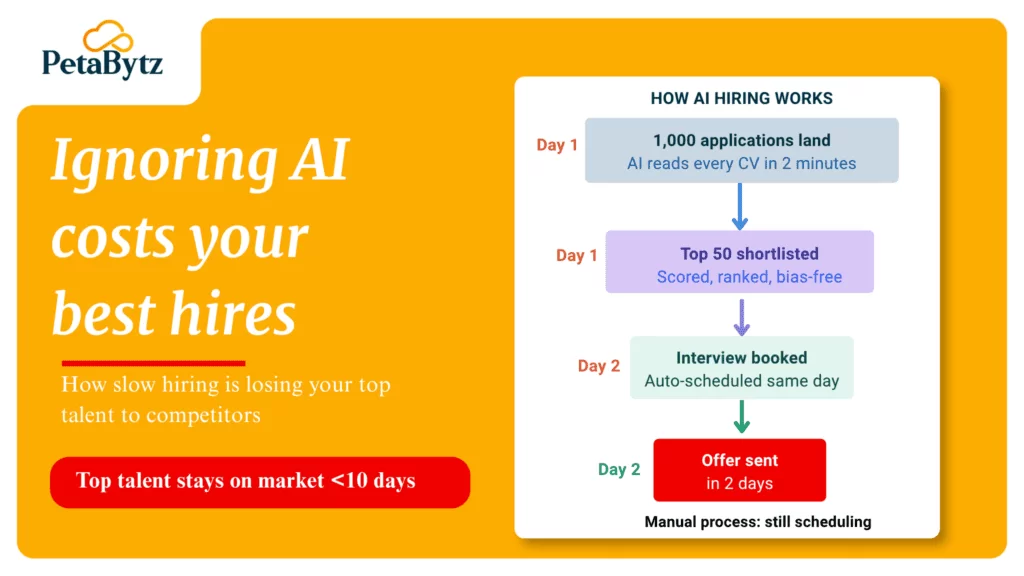
Ignoring AI in recruitment could cost you your best hires
12/05/2026
You found the perfect candidate. Strong resume. Great interview feedback. Then silence. They accepted an offer somewhere else three days before you sent yours.
This is not a one-off. It is happening to hiring teams every single day. And in most cases, the root cause is the same: a slow, manual hiring process that was never built for the speed today’s talent market demands.
The good news? AI in recruitment is not the future anymore. It is the present. And companies already using it are pulling your best candidates right out of your pipeline.
In this guide, you will learn:
- Why the hiring crisis is already affecting your pipeline
- What your competitors are doing differently with AI in recruitment
- The real hidden costs of sticking to manual processes
- Where AI actually helps — without replacing the human element
- How to start small and scale smart with AI recruiting tools
- What happens if you keep waiting
Contact us now
Ignoring AI in Recruitment Could Cost You Your Best Hire
The hiring crisis is already here
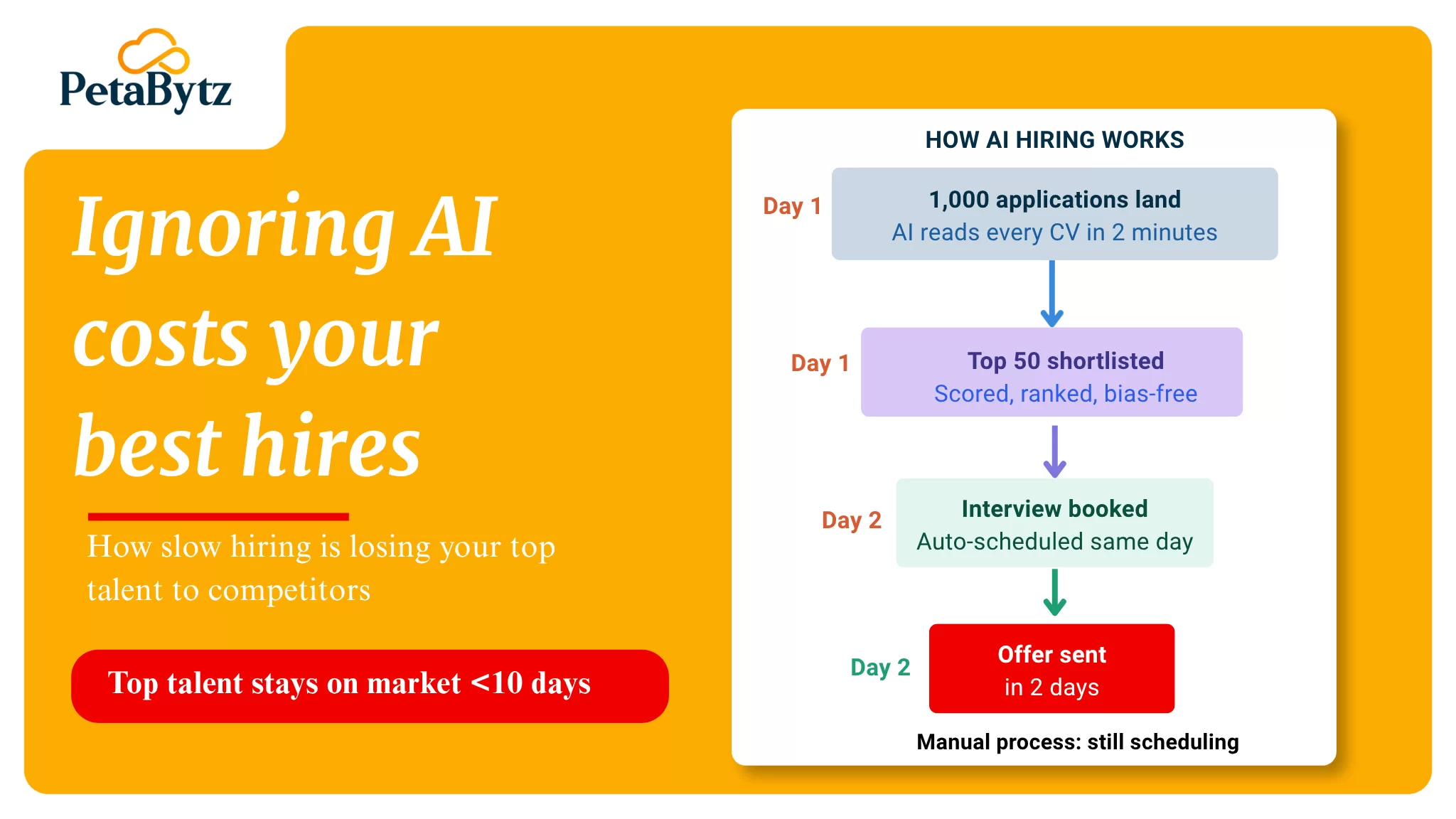
The numbers are not pretty. Average time-to-fill across industries has crept past 40 days. Candidate drop-off rates during long hiring cycles have spiked. And top talent — the kind you actually want — typically stays on the market for fewer than 10 days before accepting an offer.
Meanwhile, talent shortages are hitting nearly every sector. Tech. Healthcare. Finance. Retail. The demand for skilled workers has far outpaced the supply. And when there are fewer qualified candidates to go around, the ones who exist have options.
AI in recruitment directly addresses the speed problem. It removes the lag between application and response. It cuts screening time from days to minutes. And it keeps candidates engaged when they are most interested — right at the start.
Without it, you are playing a slow game in a fast market. And slow does not win.
What your competitors are doing differently with AI recruiting
Your competitors are not hiring faster because they have more staff. They have smarter systems.
Companies using AI for recruiting are screening hundreds of resumes in the time it takes a recruiter to review ten. They are sending personalised outreach automatically, scheduling interviews without back-and-forth emails, and ranking candidates by fit before a human even picks up the phone.
AI recruiting solutions are also helping these companies respond to candidates faster. When a candidate applies, they hear back the same day — sometimes within the hour. That responsiveness alone changes the candidate experience dramatically.
The result? Competitors are closing offers in two weeks. You are still scheduling your second interview.
AI in recruitment is not just a tool upgrade. It is a competitive advantage that compounds over time.
The hidden costs of manual recruitment
Most hiring managers think about the cost of a bad hire. Fewer think about the cost of a slow one.
Every day a role sits vacant, you are losing productivity. Projects stall. Teams stretch thin. Revenue-generating work gets delayed. The Society for Human Resource Management estimates the average cost of a bad or delayed hire runs between 50% and 200% of the annual salary for that role.
And there is the human cost too. Recruiters buried in manual screening and scheduling burn out fast. Time they could spend building relationships and evaluating fit gets eaten up by admin work.
Manual recruitment also introduces inconsistency. Different recruiters evaluate resumes differently. Biases — conscious or not — creep in. Good candidates get missed. Weak ones move forward.
AI in recruitment standardises the process, reduces human error, and surfaces the right candidates faster. The hidden costs of not using it are far greater than the cost of adopting it.
Where AI actually helps without replacing humans
Let us clear something up. AI in recruitment is not about removing the human from hiring. It is about removing the friction.
Here is where AI recruiting tools actually make a difference:
- Resume screening: AI parses thousands of applications against your job criteria in seconds. No more spending Monday mornings buried in CVs.
- Candidate ranking: AI recruiting solutions score and rank candidates based on skills, experience, and role fit — so your recruiter starts with the best, not the pile.
- Interview scheduling: Automated scheduling removes the email tennis. Candidates book a time that works for everyone, instantly.
- Bias reduction: Structured AI screening applies the same criteria to every candidate, reducing the influence of unconscious bias in early-stage filtering.
- Predictive hiring: Advanced AI for recruiting uses historical data to predict which candidates are most likely to succeed and stay — helping you make smarter long-term hires.
- Candidate engagement: Automated but personalised communication keeps candidates warm throughout the process — reducing drop-off from top applicants.
AI in recruitment handles the high-volume, low-judgement work. Your team handles the high-judgement, high-value conversations. That is the right balance.
Real industries feeling the impact of slow hiring
The cost of ignoring AI in recruitment hits differently depending on your industry. But it hits everywhere.
IT and technology
Software engineers and cloud architects are off the market in under a week. Every day of delay in your process is a day a competitor closes the deal. AI recruiting dramatically compresses the time from application to offer — which in tech, is everything.
Healthcare
Nurse and clinical staff shortages are critical. A two-week delay in filling a single nursing role can cost a hospital tens of thousands in agency staff fees. AI for recruiting helps healthcare organisations identify, screen, and onboard clinical talent faster — with compliance checks built in.
Retail and logistics
High-volume hiring with high turnover rates makes AI recruiting solutions a necessity, not a luxury. AI screens volume applicants at scale, filters for availability and fit, and fills shifts before the season peak hits.
Finance and professional services
Compliance and credential verification slow down financial sector hiring. AI in recruitment automates document checks, credential verification, and risk screening — cutting weeks off the process without cutting corners.
What happens if you wait
Inaction in hiring has a compounding cost. Every month without AI in recruitment is another month your competitors pull ahead.
Candidates who have a slow, unresponsive experience with your brand do not forget it. They leave reviews. They tell their networks. Employer brand damage is real — and it directly impacts the quality of future applicants.
There is also the talent pool problem. As more companies adopt AI recruiting tools, the best candidates gravitate to employers who offer a faster, more respectful hiring experience. If your process still takes six weeks, you are self-selecting for candidates who were not in demand elsewhere.
Waiting does not preserve the status quo. It accelerates your fall behind.
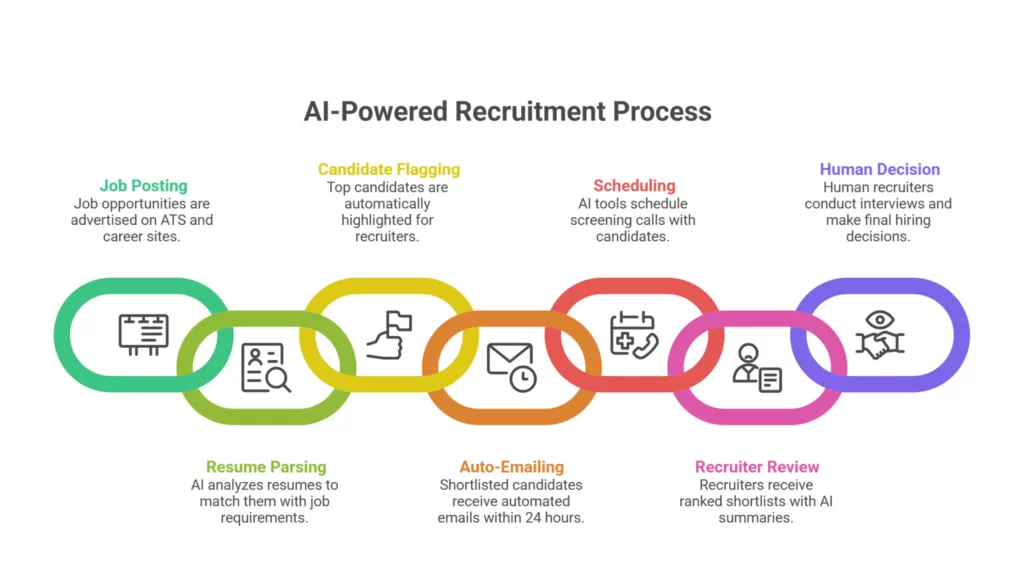
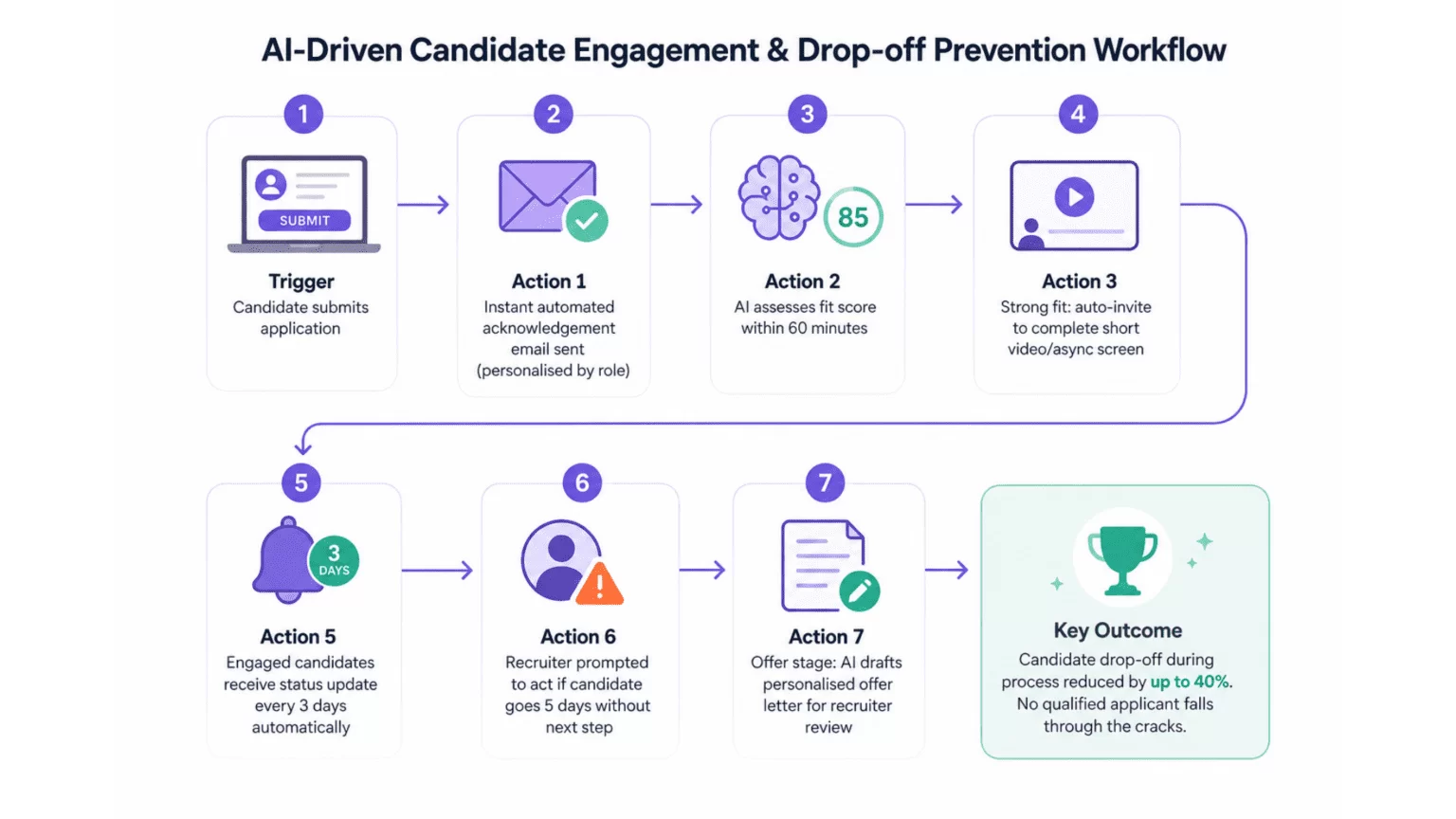
AI in recruitment workflow
These two workflow templates map the key stages where AI in recruitment can cut time, reduce drop-off, and improve candidate quality.
1: AI-powered candidate screening workflow
2: AI-driven candidate engagement and drop-off prevention workflow
Suggested Reading:
Stop Hiring, Start Calling: How an AI Voice Bot Scales Sales at 5× SpeedBest practices to improve your AI recruiting process
- Start with your biggest bottleneck — Do not try to automate everything at once. Identify where your process bleeds the most time — usually resume screening or scheduling — and deploy AI there first. Quick wins build momentum.
- Keep humans in the loop at key touchpoints — AI in recruitment works best when it handles volume and humans handle judgement. Never let AI make final hiring decisions. It is a filter, not a decider.
- Train your AI on quality data — The quality of your AI recruiting tools is only as good as the data you feed them. Audit your historical hiring data for bias before using it to train your screening model.
- Communicate AI use to candidates transparently — Candidates increasingly want to know how their application is being evaluated. Being upfront about using AI for initial screening builds trust and improves your employer brand.
- Measure and iterate continuously — Track time-to-fill, offer acceptance rates, and candidate satisfaction scores before and after AI implementation. Use the data to refine your process every quarter.
- Integrate AI with your existing ATS — The best AI recruiting solutions do not replace your existing tools — they plug into them. Look for tools that integrate with your ATS, calendar, and communication stack to avoid creating silos.
How to start small and scale smart with AI in recruitment
You do not need to overhaul your entire hiring process overnight. That is not how successful AI adoption works.
Start with one use case. Resume screening is the most common entry point. Implement AI for recruiting at the top of your funnel — where volume is highest and human time is most wasted. Once that is running, layer in scheduling automation. Then candidate ranking. Then predictive analytics.
The key is integration over replacement. Your recruiters do not disappear. They get upgraded. They spend less time sorting and more time selling your employer brand to the right people.
If you are looking for a structured way to assess your readiness and deploy AI in recruitment without getting lost in complexity, Petabytz helps organisations identify the right AI tools, integrate them into existing workflows, and measure ROI from day one — so you move fast without breaking your process.
Conclusion — the best candidates will not wait for you
You do not need to overcomplicate this. AI in recruitment is not a moonshot. It is a process upgrade — one that your competitors are already running while you are still sorting spreadsheets.
The hiring crisis is real. The candidate drop-off is real. The compounding cost of delay is real. But so is the opportunity to fix it — right now, with tools that exist today.
Every week you wait is another week a faster, smarter competitor fills the roles you needed. Every candidate who does not hear back is a future brand ambassador turned brand detractor.
You have the knowledge. You have the urgency. Now take the step. Explore how AI in recruitment can transform your hiring pipeline — and make sure it is your offer your best candidates accept.
Website: www.petabytz.com
Email: info@petabytz.com
Ready to move faster than your competitors? Talk to Petabytz today
Contact UsFrequently Asked Questions (FAQ’s)
Q1. What is AI in recruitment and how does it work?
AI in recruitment uses machine learning and automation to screen resumes, rank candidates, schedule interviews, and reduce time-to-fill. It helps hiring teams move faster without sacrificing quality or adding headcount.
Q2. Will AI recruiting tools replace human recruiters?
No. AI recruiting tools handle repetitive, high-volume tasks. Human recruiters still drive relationship-building, culture assessment, and final hiring decisions. AI makes recruiters more effective, not redundant.
Q3. How do AI recruiting solutions help reduce hiring bias?
AI recruiting solutions apply consistent, objective criteria to every application. This reduces the impact of unconscious bias in early screening. When trained on unbiased data, AI for recruiting can produce fairer shortlists than manual review.
Q4. Is AI in recruitment suitable for small businesses?
Yes. Many AI in recruitment platforms offer scalable pricing and plug-and-play integrations. Small businesses can start with basic resume screening or scheduling tools and expand as hiring volume grows
Recent Posts