INDIA
INDIA
 USA
USA CANADA
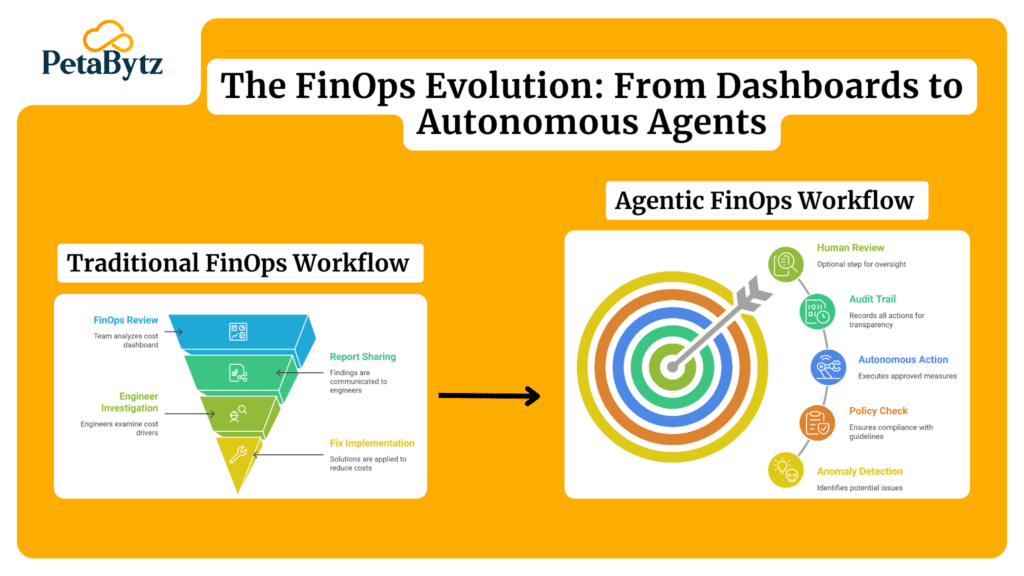
The FinOps Evolution: From Dashboards to Autonomous Agents
27/04/2026
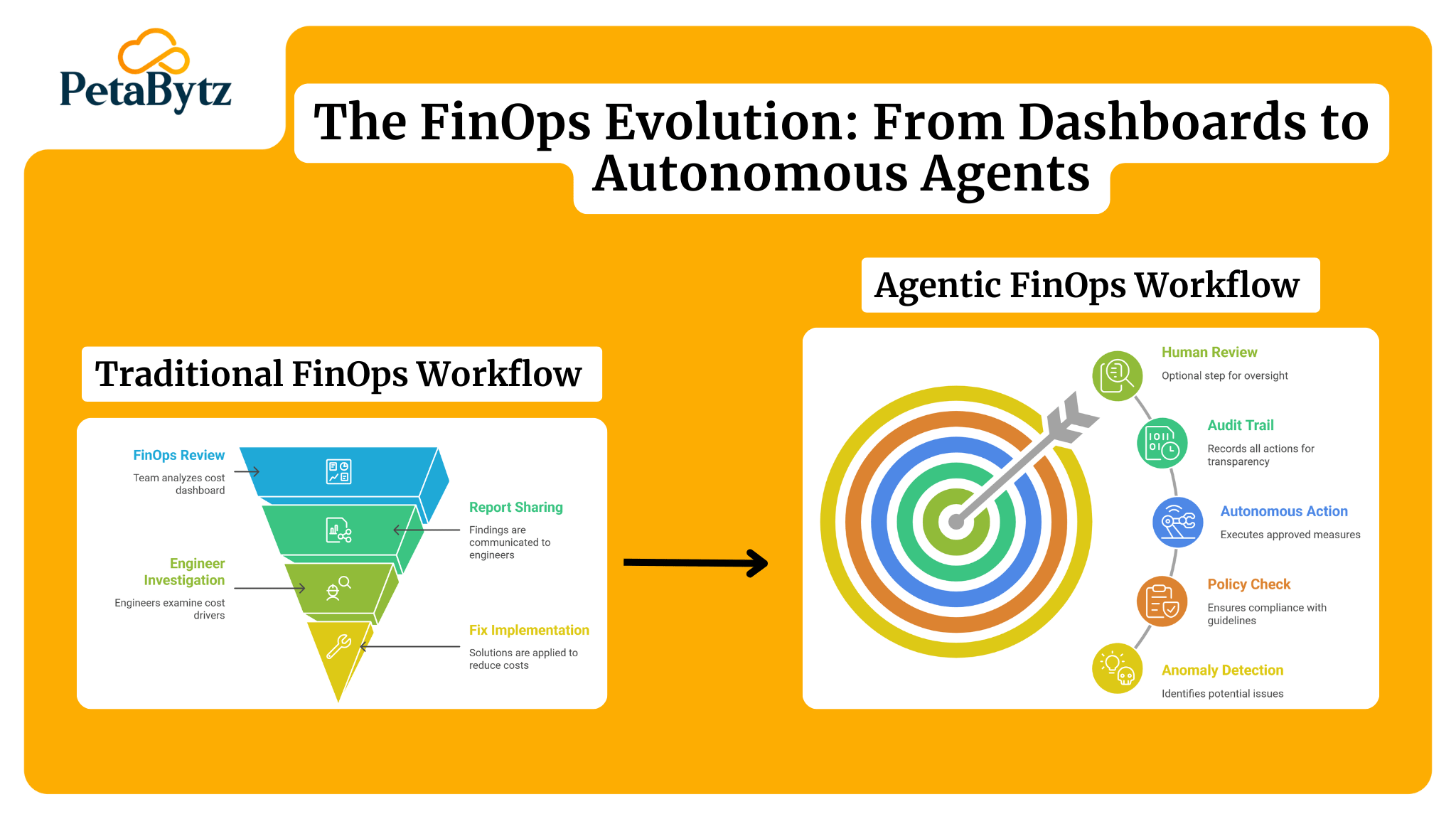
Your cloud bill arrives. It’s 23% higher than last month. You pull up your FinOps dashboard. You see the spike. You even know why. But by the time your engineers investigate, prioritize, and act three days have passed and the damage is done.
That gap between seeing a problem and fixing it is costing companies millions every year. Traditional FinOp gave us visibility. But visibility without execution is just an expensive mirror.
A new generation of FinOp is here. One where AI agents don’t just report the problem they fix it, autonomously, in real time.
In this guide, you’ll learn:
- Why traditional FinOps tools are no longer enough
- How autonomous agents execute real-time cloud cost decisions
- The real financial cost of cloud waste at scale
- Real-world use cases and measurable ROI from agentic FinOps
- How to evaluate, buy, and implement an agentic FinOps solution
Contact us now
FinOps in 2026: From Dashboards to Autonomous Agents
FinOps – short for Financial Operations – started as a cultural shift. Engineering, finance, and business teams finally started talking about cloud costs together. That was progress.
The first wave of FinOps tools gave us dashboards, tagging frameworks, and cost allocation reports. Teams could finally answer: “Where is our cloud money going?” The FinOp Foundation formalized this with a maturity model: Crawl, Walk, Run.
Most organizations are still stuck in “Walk.”
They have FinOps platforms. They have recommendations. They have weekly cost review meetings. But the execution is still manual, slow, and dependent on engineer bandwidth that is always scarce.
The second wave of FinOps is different. It is agentic. AI agents now monitor your cloud environment continuously, identify waste, and act on it – without waiting for a human to open a ticket.
This is not just an upgrade to existing FinOps tools. It is a fundamental shift in what FinOps means.
How autonomous agents work in cloud cost optimization
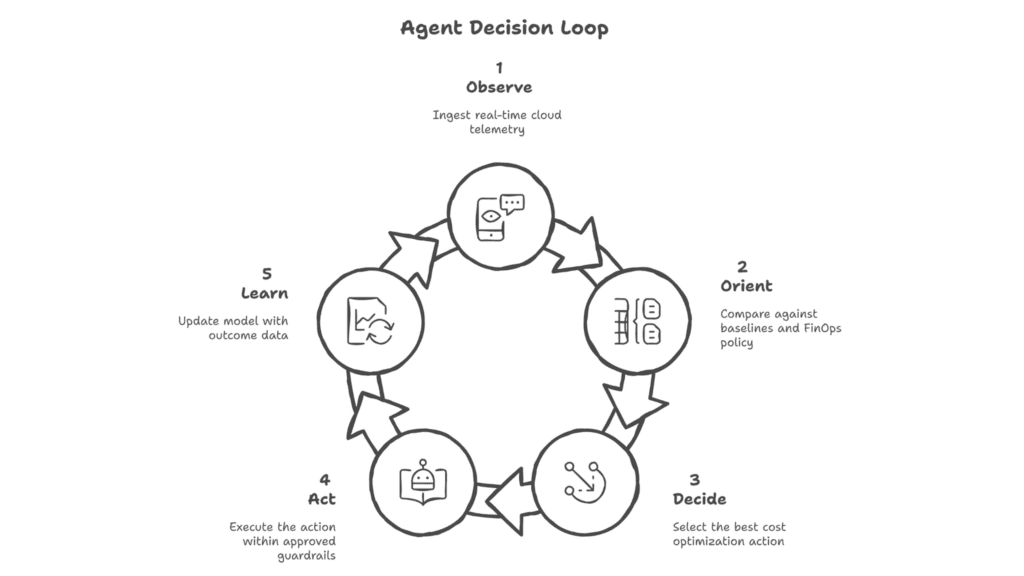
An autonomous FinOps agent is not a smarter alert. It is a decision-making system that perceives, plans, and acts.
Here is how a mature agentic FinOps system operates across your cloud environment:
Continuous monitoring:
The agent ingests telemetry from AWS FinOps tools, Azure Cost Management, GCP Billing, and Kubernetes clusters. It watches CPU usage, memory consumption, network throughput, and spend per tag, per team, per environment — simultaneously.
Anomaly detection:
Using ML models trained on your historical spend patterns, the agent flags deviations that would take a human analyst hours to spot. A data pipeline suddenly doubling egress costs. A dev environment left running over a weekend. A reserved instance expiring unnoticed.
Policy-governed execution:
Before acting, the agent checks your FinOps policy rulebook. Can it rightsize this EC2 instance without disrupting production SLAs? Is shutting down this cluster within approved hours? If the action is within bounds, it executes. If not, it escalates.
This is what separates a real agentic FinOps system from a simple automation script. The agent reasons. It does not just react.
The real cost of cloud waste – and why humans cannot keep up
Let the numbers do the talking.
- The Flexera 2024 State of the Cloud Report found that organizations waste an average of 28% of their cloud spend.
- Gartner estimates global cloud overspend will exceed $100 billion annually by 2026.
- The average enterprise runs workloads across 3.4 clouds — making manual FinOps near impossible at scale.
- FinOps teams spend 60%+ of their time gathering data, not acting on it.
The human bandwidth problem is real. Cloud environments generate millions of cost-related events per day. No team, no matter how good their FinOps solutions, can review and act on all of them manually.
The cost of inaction is not just the wasted spend. It is the engineering hours diverted to cost reviews instead of product work. It is the opportunity cost of slow decisions. It is the compound effect of small inefficiencies that nobody has time to fix.
Traditional FinOps was designed for a simpler era. Agentic FinOps was designed for the cloud at the scale we actually operate at today.
Agentic FinOps in action: use cases and measurable ROI
Theory is useful. Results are better. Here are three scenarios where agentic FinOps has driven measurable outcomes.
Use case 1: e-commerce peak load optimization
A mid-market e-commerce platform scales aggressively ahead of flash sales. After the event, instances stay over-provisioned for days. An agentic FinOps system monitors post-event traffic patterns, identifies the surplus, and begins rightsizing within hours of the peak dropping. Result: 34% reduction in compute costs the week following major sale events.
Use case 2: fintech compliance-aware cost allocation
A fintech company must allocate cloud costs per regulatory entity while maintaining real-time FinOps visibility. Agents tag resources dynamically, enforce allocation policies, and flag compliance violations before month-end reporting. Result: 80% reduction in manual tagging effort, zero misallocations in audit.
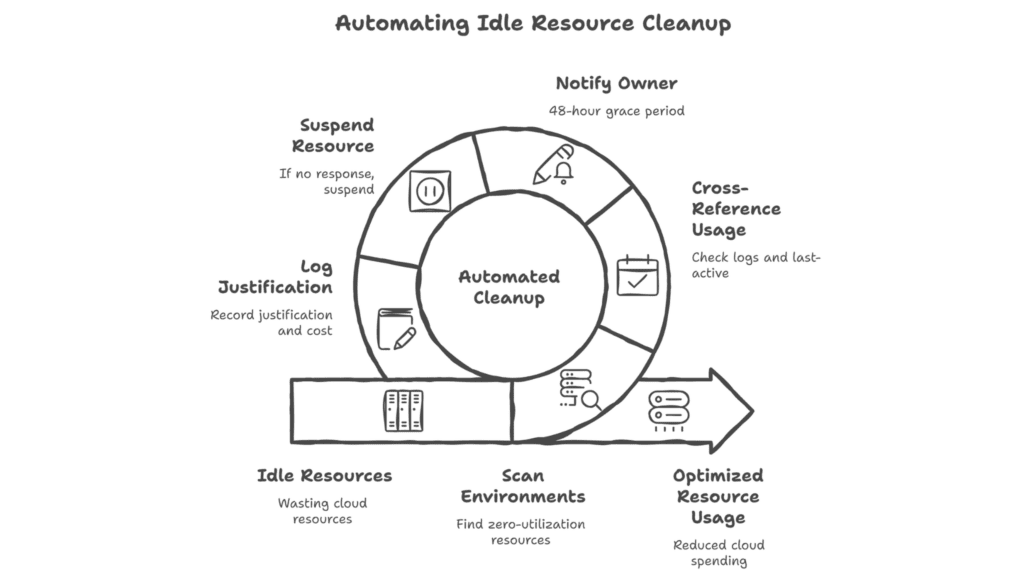
Use case 3: SaaS multi-tenant idle resource cleanup
A SaaS provider runs per-tenant environments. Inactive trial accounts leave resources running indefinitely. An agentic FinOps system identifies idle environments, confirms inactivity against usage logs, and automatically suspends them. Result: $180,000 saved annually from idle resource elimination.
Risks, guardrails, and governance in autonomous FinOps execution
The most common objection to agentic FinOps is this: “What if the agent does something wrong?”
It is a fair question. And the answer is: good agentic FinOps systems are designed around this concern from the ground up.
Policy-first architecture:
Every action an agent can take is governed by a policy rulebook you define. You set the boundaries: which resource types can be modified, in which environments, during which hours, up to what spend threshold. The agent operates within those walls.
Human-in-the-loop overrides:
For high-impact actions — say, terminating a cluster above a certain cost threshold — the agent can be configured to pause and request human approval. This gives you full autonomous execution for routine optimization, with manual review for the big calls.
Full audit trail:
Every agent action is logged: what it did, why it did it, what policy it referenced, and what the cost impact was. This is essential for regulated industries like fintech and healthcare, where FinOps decisions need to be auditable.
Autonomous does not mean unaccountable. The best agentic FinOps systems make your cloud operations more transparent, not less.
Buyer’s evaluation checklist: what to look for in an agentic FinOps solution
Not all FinOps platforms are equal. Here is what to look for before you sign a contract.
- Multi-cloud coverage: Does it support AWS FinOps, Azure, and GCP natively? Or is it primarily one-cloud with bolt-on support?
- Execution depth: Can it actually take actions, or does it only make recommendations? Recommendations are table stakes in 2025.
- Policy customization: How granular can you get with guardrails? Can you set different rules per team, environment, and resource type?
- Audit and compliance: Does every action produce a timestamped, exportable audit log? Critical for fintech, healthcare, and government workloads.
- Integration with your stack: Does it connect to your existing FinOps tools, ITSM platforms, and alerting systems?
- Time to value: How long before you see the first autonomous saving? Weeks is acceptable. Months is a warning sign.
- Reporting and attribution: Can it show you, at the team or project level, exactly how much was saved and by what action?
Use this as your shortlist filter. Any vendor who cannot answer all seven clearly is not ready for enterprise FinOps.
Your 30-day roadmap to getting started with agentic FinOps
You do not need to rip out your existing FinOps stack. Start small, prove value fast, then expand.
Days 1–10: audit and baseline
- Map your top 5 cloud cost drivers
- Identify 3 categories of recurring waste (idle resources, oversized instances, unused reservations)
- Define your FinOps policy boundaries for autonomous action
Days 11–20: pilot
- Deploy agentic FinOps in one environment (dev or staging)
- Configure guardrails and escalation thresholds
- Let the agent run in “observe + recommend” mode before enabling execution
Days 21–30: scale
- Enable autonomous execution for approved action types
- Expand to production environments with tighter guardrails
- Review the first monthly savings report and refine policy.
How agentic AI services connect FinOps to real financial outcomes
Most FinOps implementations stall not because of bad intentions, but because of a gap between recommendation and execution. Teams know what to fix. They just cannot fix it fast enough.
Agentic AI services for fintech bridge that gap. They combine deep cloud cost intelligence with the ability to act, autonomously, at machine speed, within the guardrails your team defines.
Petabytz brings this capability to organizations running complex, multi-cloud fintech infrastructure. Our agentic FinOps approach is not a bolt-on feature — it is an end-to-end operating model that plugs into your existing AWS FinOps stack, Azure environment, or hybrid architecture.
If you are still running FinOps manually in 2025, you are leaving significant money on the table. The question is not whether to adopt agentic FinOps. It is how fast you can get there.
Conclusion
You do not need to overcomplicate this.
FinOps started as a way to create shared accountability for cloud costs. That mission has not changed. What has changed is the scale of the problem — and the tools available to solve it.
Agentic FinOps does not replace your team. It removes the manual drudgery that was slowing your team down. It means your engineers spend less time in cost review meetings and more time building. Your FinOps practitioners move from reactive reporting to proactive strategy.
The cloud is not slowing down. Cloud costs are not getting simpler. But with the right agentic FinOps system in place, you can stay ahead of both.
Ready to move beyond dashboards? Talk to the team at Petabytz about what agentic FinOps looks like for your infrastructure.
Frequently Asked Questions (FAQ’s)
What is FinOps and why does it matter?
FinOps is a cloud financial management discipline that brings engineering, finance, and business teams together to control and optimize cloud spend. It matters because cloud costs scale fast — and without FinOps, they scale out of control.
What are the best FinOps tools available in 2026?
Top FinOps platforms include AWS Cost Explorer, Azure Cost Management, CloudHealth, Apptio Cloudability, and emerging agentic FinOps solutions. The best tool depends on your cloud mix, team size, and whether you need recommendations or autonomous execution.
How is AI FinOps different from traditional FinOps?
Traditional FinOps relies on human review cycles and manual action. AI FinOps uses machine learning to detect anomalies and autonomous agents to execute cost-saving actions in real time, without waiting for human intervention at every step.
Is agentic FinOps safe for production environments?
Yes, when implemented with proper policy guardrails. Mature agentic FinOps systems allow you to set strict boundaries on what actions agents can take in production, require human approval for high-impact changes, and maintain full audit logs of every decision.
Recent Posts