INDIA
INDIA
 USA
USA CANADA
The Agentic Enterprise: 7 Strategic Moves That Will Separate Winners From Laggards
13/05/2026
Your competitor just cut their quote turnaround from 48 hours to 4 minutes. You are still waiting on three approvals and a spreadsheet from finance.
That gap is not a technology gap. It is a strategy gap.
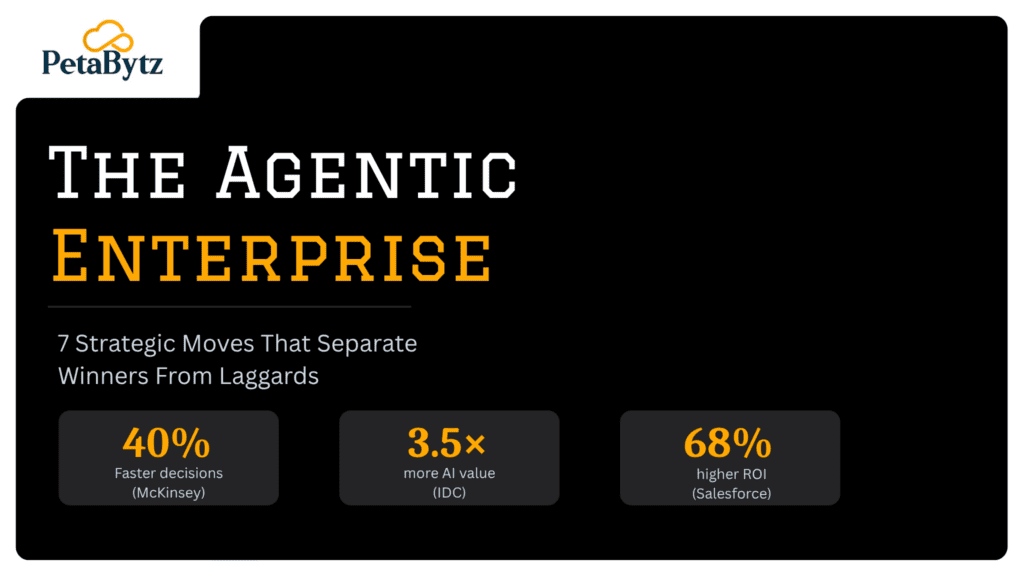
The agentic enterprise is not a future concept. It is happening right now. According to McKinsey, companies that deploy AI at scale report up to 40% faster decision cycles and 20–30% reduction in operational costs within the first year. Yet Gartner reports that only 12% of enterprises have moved beyond pilot-stage AI to production-grade agentic systems.
The companies building the agentic enterprise today are not just automating tasks. They are delegating decisions. Their systems act, adapt, and close loops — without waiting for a human to hit approve.
If you are still operating on last decade’s playbook, this guide is your wake-up call.
In this guide, you will learn:
- What truly separates the agentic enterprise from traditional automation
- 7 strategic moves every enterprise leader must make right now
- Practical workflow orchestration templates for AI agent pipelines
- Best practices for governing autonomous agents safely and at scale
- How to embed agentic thinking across your entire leadership team

Contact us now
The Agentic Enterprise: 7 Moves to Win in 2026
Move 1: Automate decisions, not just tasks
From script-following bots to judgment-driven agents
Most enterprises are still running RPA — systems that execute fixed steps and stop the moment something unexpected happens. A Forrester study found that 72% of RPA deployments fail to scale beyond their original pilot because they cannot handle decision-making.
The agentic enterprise flips this completely. AI agents for enterprise do not follow scripts — they perceive context, weigh options, and act.
- A pricing agent monitors competitor moves in real time and adjusts your rates automatically — no approval queue needed.
- An RPA bot fills a form. An agentic AI reads the customer’s history, checks inventory, evaluates margin, and either completes or escalates — with a reason.
- Companies using decision-layer agents report up to 60% fewer manual escalations in high-volume workflows.
- The best AI agents handle ambiguity — they know when to act and when to ask a human, making them far more robust than rigid automation.
The shift from task execution to judgment plus action is the defining characteristic of the agentic enterprise. Every competitive advantage you build compounds from this single move.
Move 2: Redesign for speed-to-decision
Collapse the approval chain before a competitor does it for you
Traditional org hierarchies were built for control — every decision climbs a chain, every approval adds hours. Harvard Business Review found that executives spend 37% of their time in meetings to make decisions that an agentic AI architecture could route in seconds.
The agentic enterprise does not just speed up old workflows. It redesigns the logic of how decisions flow.
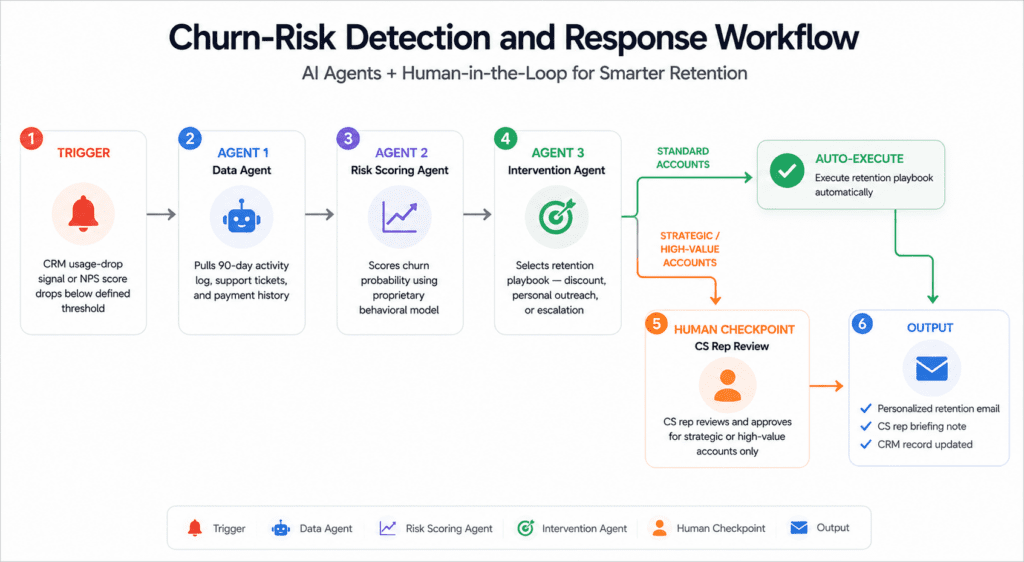
- Before: A churn-risk flag goes through 3 approval layers before a retention offer lands. Average response time — 3 days.
- After: An agentic AI detects the churn signal, selects the right retention playbook, and sends a personalized offer — in under 20 minutes.
- Enterprises using agentic decision routing report 55% shorter sales cycles on qualified leads.
- Agentic AI architecture routes by risk and value — low-stakes decisions run automatically; high-stakes ones trigger the right human instantly.
Speed-to-decision is the new competitive moat. And unlike product features, it is very hard to copy once it is baked into your operations.
Move 3: Build moats through proprietary data loops
Generic agents are a commodity. Yours should not be
AI agents are only as powerful as the data they run on. IDC projects that enterprises with strong proprietary data pipelines will generate 3.5x more value from AI investments than those using off-the-shelf models alone.
The agentic enterprise builds data flywheels that compound over time — and that no competitor can replicate.
- Every agent interaction generates new data. That data trains better agents. Better agents make sharper decisions. This loop is self-reinforcing.
- Agentic AI news is full of enterprise M&A for one reason: companies are buying data assets, not just AI tools.
- Enterprises that connect agents to proprietary operational data see 45% higher accuracy in predictions versus generic model baselines.
- Your best AI agents will be built on your customers, your transactions, your history — not public internet data.
Start building your proprietary data loop today. The agentic enterprise that owns its data flywheel will be impossible to dislodge.
Move 4: Shift from headcount to agent capacity
Workforce planning just changed completely
The old question was: how many people do we need to hire? The agentic enterprise asks something different. Deloitte found that AI agents can handle 80% of repeatable knowledge work at a fraction of the cost of a full-time hire.
Resource allocation in the agentic enterprise is about agent orchestration — not hiring cycles that take 90 days to close.
- AI agents for enterprise scale horizontally and instantly — when demand spikes on a Monday morning, they do not need overtime approvals.
- You do not onboard agents. You deploy them. You do not retrain them in classrooms. You retrain them with data.
- Organizations that shift workforce planning to agent capacity models report 30% lower cost-per-outcome in operations within 18 months.
- Human effort gets redirected to creativity, relationships, and judgment calls that require emotional intelligence — where it actually creates irreplaceable value.
This is not about replacing people. It is about reallocating them to higher ground — and giving agents everything else.
Move 5: Rethink risk and governance
The enterprises that govern agents well will move fastest
Autonomous agents create new failure modes at scale. A 2024 MIT Sloan study found that 62% of early agentic AI deployments hit compliance or trust issues within the first six months — because governance was an afterthought.
The agentic enterprise does not treat governance as a blocker. It builds governance as infrastructure — light, precise, and always traceable.
- A strong agentic AI framework includes guardrails, escalation logic, audit trails, and human-in-the-loop checkpoints for high-stakes decisions.
- A wrong pricing agent decision can cost margin at scale. A misread compliance signal can trigger regulatory exposure. Govern before you scale.
- Well-governed agents earn trust — and trusted agents get expanded scope. Poor governance freezes the whole agentic enterprise in place.
- Enterprises with formal AI governance frameworks are 2.4x more likely to report positive ROI from their agentic deployments, per Accenture research.
The goal is not to slow agents down with red tape. It is to build oversight so lean that agents barely feel it — but humans always can.
Move 6: Create cross-functional agent networks
Siloed AI tools lose. Networked agents win
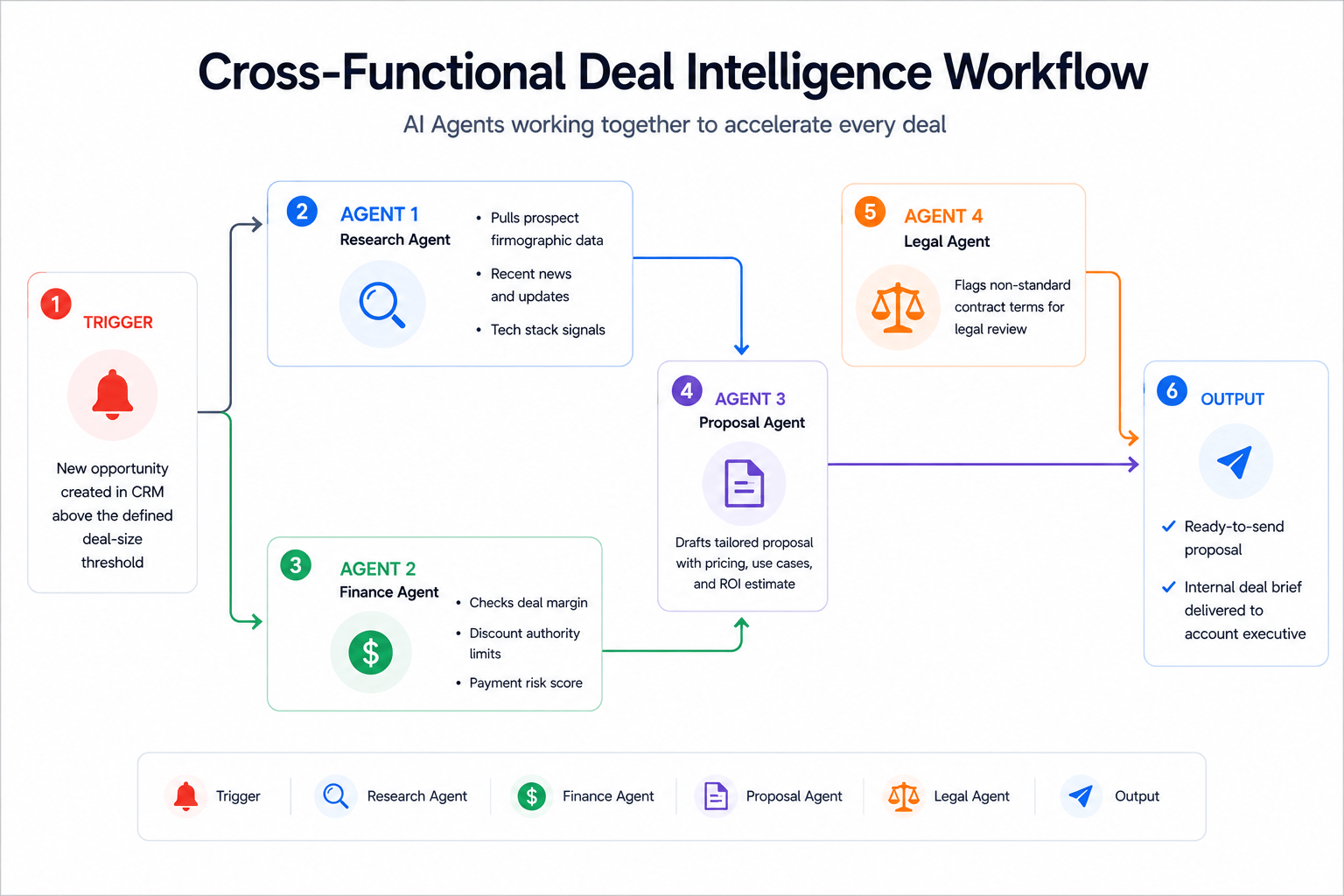
A sales agent that cannot talk to the finance agent is half an agent. Salesforce research shows that enterprises with connected agent pipelines across three or more functions see 68% higher ROI than those running point solutions in isolation.
The agentic enterprise wires agents together — sales, operations, finance, and customer success — into one interconnected agentic AI architecture.
- When a deal closes, the fulfillment agent fires automatically. When support flags a product issue, the engineering agent picks it up. No human relay needed.
- A shared agentic AI framework ensures agents pass context — not just data. The downstream agent knows why, not just what.
- Cross-functional agent networks eliminate the 21% of working time employees currently spend searching for information across departments (McKinsey).
- The best AI agents do not operate alone. They trigger, inform, and hand off to each other — creating compound intelligence across the agentic enterprise.
Networked agents are exponentially more valuable than isolated ones. The agentic enterprise connects them — and that connection is the real competitive weapon.
Move 7: Embed agentic thinking in leadership
Culture is the last mile — and the hardest one
All six moves above fail without this one. PwC found that 74% of employees feel unprepared to work alongside AI systems — not because of the technology, but because leadership never gave them a new mental model for it.
CEOs and boards in the agentic enterprise need to redefine what running the business actually means — orchestrating humans and agents together, not just managing headcount.
- Board reporting in the agentic enterprise includes agent performance metrics — uptime, decision accuracy, escalation rates, and cost-per-output.
- Strategic planning roadmaps agent capacity alongside headcount — because both are now core to delivery.
- Leaders who adopt agentic thinking attract a new class of talent — people who want to work at human-agent boundaries, not away from them.
- Organizations where the CEO actively champions the agentic enterprise see 3x faster adoption than those where it is delegated entirely to IT.
The agentic enterprise is ultimately a leadership story. Those who internalize it will compound their advantage. Those who delegate and wait will keep chasing competitors who stopped running the same race two years ago.
1: Churn-risk detection and response workflow
2: Cross-functional deal intelligence workflow
Suggested Reading:
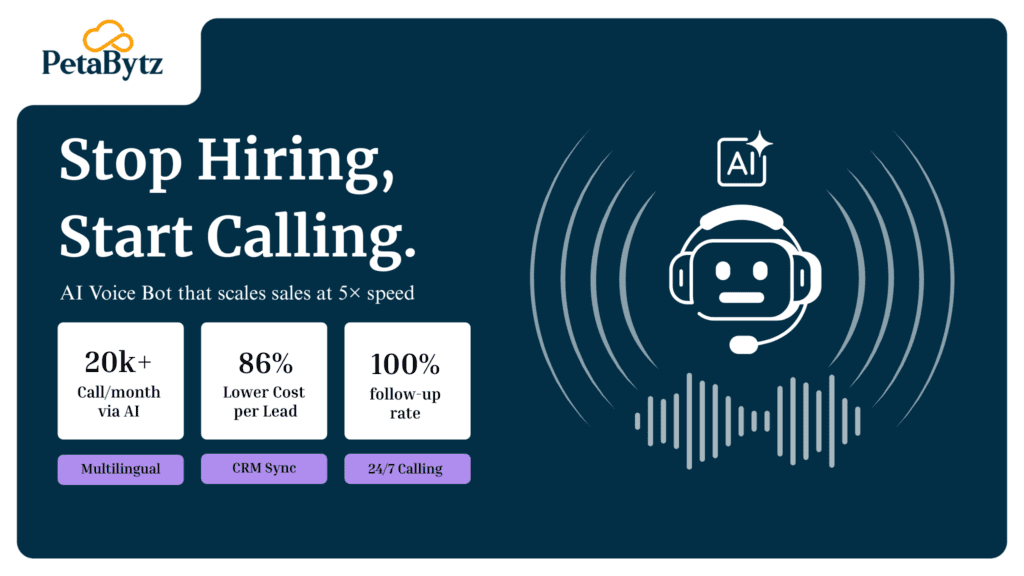
Stop Hiring, Start Calling: How an AI Voice Bot Scales Sales at 5× SpeedBest practices to build your agentic enterprise the right way
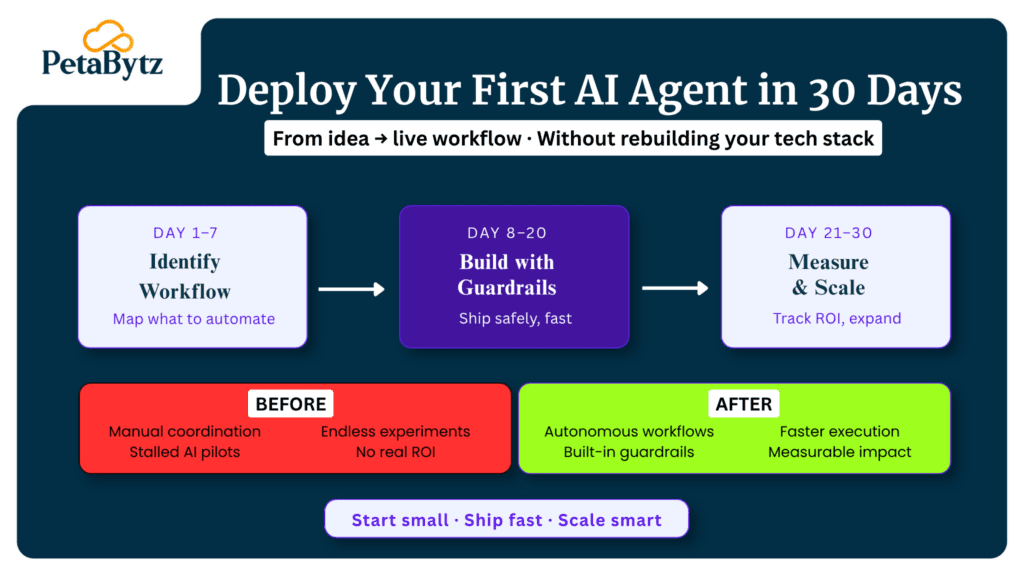
- Start with one high-value workflow, not the whole organization. Pick a process with measurable cycle time, clear inputs, and a defined output. Win there first. Then expand the agentic enterprise from that proof point.
- Design for failure, not just success. Every agentic AI framework needs explicit fallback paths. What happens when an agent gets ambiguous data? When confidence is too low? Define this before launch, not after your first incident.
- Build observability from day one. Log every agent decision. Track outcomes. Run retrospectives on agent errors like production incidents. You cannot govern what you cannot see — and ungoverned agents stall the whole agentic enterprise.
- Align incentives before deployment. If your sales team is measured on call volume and an agent handles 40% of those calls, something must change. Address comp, metrics, and accountability before you go live.
- Treat data quality as a first-class concern. Bad data produces bad decisions at machine speed. Audit your pipelines before connecting them to the agentic enterprise. Agents amplify quality — and they also amplify garbage.
- Be honest with your team about what changes. Agentic AI news triggers fear. Tell your people what agents will handle, what humans will own, and how success gets measured for both. Transparency builds adoption.
How Petabytz helps you build the agentic enterprise
Every enterprise leader reading this faces the same core challenge. The vision for the agentic enterprise is clear. The execution is where most teams stall.
Where do you start? Which agents do you build first? How do you connect them across functions without creating new silos? How do you govern the agentic enterprise without slowing it down?
This is exactly where Petabytz comes in. As a specialized Agentic AI Service, Petabytz works with enterprise teams to design, deploy, and orchestrate AI agents across sales, operations, finance, and customer success.
Their approach is grounded in the same agentic AI architecture and agentic AI framework principles covered throughout this guide. They do not sell generic AI tools. They build agent networks tailored to your workflows, your proprietary data, and your specific risk tolerance.
If you are ready to move from strategy to execution on the agentic enterprise, Petabytz gives you the technical depth and implementation experience to get there faster — and safer.
Conclusion: The agentic enterprise is a choice you make now
You do not need to overcomplicate this. The agentic enterprise is not about deploying every AI tool on the market. It is about making seven deliberate strategic shifts — in how you automate decisions, organize for speed, build with data, plan your workforce, govern risk, wire your teams, and lead with a new mindset.
The companies winning right now started with one workflow and one agent. They governed it tightly, learned from it, and expanded. They built the agentic enterprise from the inside out — and by the time competitors noticed, the gap was too wide to close.
The pace that matters is not how fast you announce an AI strategy. It is how fast you compound on it.
Start with one move from this guide. Go deep on it. Then come back for the next.
Ready to build your agentic enterprise? Talk to the team at Petabytz and start with your first agent workflow today.
Website: www.petabytz.com
Email: info@petabytz.com
Ready to move faster than your competitors? Talk to Petabytz today
Contact UsFrequently Asked Questions (FAQ’s)
Q1. What is an agentic enterprise and how is it different from a digital enterprise?
An agentic enterprise uses AI agents to autonomously perceive, decide, and act across business functions. A digital enterprise digitizes processes. The agentic enterprise goes further — it delegates judgment, not just execution, to AI systems that continuously learn and adapt from real operational data.
Q2. What are the best AI agents for enterprise use today?
The best AI agents for enterprise are purpose-built for specific workflows — sales intelligence agents, churn-risk agents, procurement agents, and finance reconciliation agents. The best AI agents combine proprietary data, a strong agentic AI framework, and clear human oversight at decision-critical boundaries.
Q3. What does an agentic AI architecture look like in practice?
An agentic AI architecture includes a trigger layer (events that activate agents), a reasoning layer (where agents interpret and decide), a tool layer (APIs and databases agents use), and a human oversight layer (escalation paths and approvals). Together these form the operational backbone of the agentic enterprise.
Q4. How do I build an agentic AI framework for my organization?
Start by identifying one workflow with clear inputs, outputs, and measurable cycle time. Map the decisions inside it. Design an agentic AI framework with guardrails, escalation logic, and audit trails. Deploy at small scale. Observe. Expand only after validating that the agentic enterprise model works for your specific context.
Recent Posts