INDIA
INDIA
 USA
USA CANADA
AI-Driven Enterprise Service Management (ESM): What You’re Missing
23/04/2026
Your IT team closes 500 tickets a month. HR still takes a week to onboard a new hire. Finance is chasing approvals over email. And somehow, everyone calls it a working system.
It’s not working. It’s just not broken enough to fix – yet.
Enterprise service management was supposed to solve this. One framework. Cross-functional workflows. Shared service desks. But most organizations deployed ESM and still have the same siloed chaos – just with a prettier dashboard.
The missing piece? AI. Not AI as a buzzword. AI as the operating layer that makes enterprise service management actually intelligent.
In this guide, you’ll learn:
- What enterprise service management really means in 2025
- Why traditional ESM implementations fall flat
- How AI transforms the ESM model from reactive to predictive
- Real-world use cases across HR, Finance, IT, and Sales
- The ROI you’re leaving on the table without AI-driven ESM
- How to start your AI-ESM journey without overhauling everything
Contact us now
AI-Driven Enterprise Service Management | ESM Guide
ITSM is evolving into ESM – and it’s about time
IT Service Management (ITSM) built the playbook. Incident management, change control, service catalogues – it gave IT teams a structured way to operate. But business grew beyond IT.
HR needed a request system. Finance needed approval workflows. Legal needed case tracking. Each department built something separate – or worse, nothing at all. Enterprise service management takes ITSM principles and extends them across the entire organization. One service model. Multiple departments. Connected workflows.
The shift sounds simple. In practice, most ESM programs fail to deliver on that promise – because they try to solve a people-and-process problem with just a platform.
What is enterprise service management?
Enterprise service management (ESM) is the application of ITSM-style practices – service catalogues, ticketing, workflows, SLAs – to non-IT business functions. Think of it as giving every department the discipline IT already has.
A mature ESM model includes a unified enterprise service desk, cross-functional service catalogues, shared workflows, and visibility across all departments. Employees submit requests once. The right team handles it. Status is transparent.
Sounds ideal. Here’s where it usually breaks down:
- Teams don’t adopt shared systems – they keep their own tools
- Workflows get built once and never updated
- The enterprise service management system becomes a ticket dump with no intelligence
- No one owns the cross-functional orchestration
That’s the gap AI was built to fill.
Why traditional ESM fails without AI
Traditional enterprise service management is rule-based. Someone defines a workflow. Someone maps approval chains. Someone writes the SLA policy.
That works – until the business changes. And the business always changes.
Without AI, your enterprise service management system is reactive. It moves when someone pushes it. It escalates when someone notices a problem. It reports on what already happened.
The result? Service desks drowning in repetitive tickets. Employees waiting days for answers that should take minutes. SLA breaches that only show up in last week’s report.
The problem isn’t your people. It’s not even your platform. It’s the absence of intelligence in your enterprise service management process.
The role of AI in enterprise service management
AI doesn’t replace your ESM platform. It makes it useful.
Here’s what AI brings to enterprise service management that rules and workflows alone never could:
Intelligent triage and routing
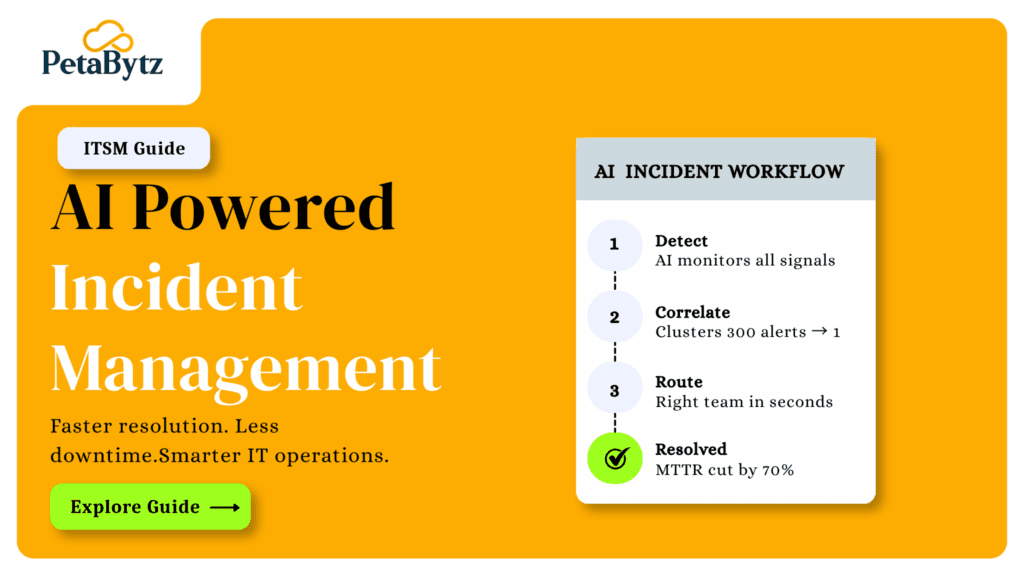
AI reads incoming requests, understands intent, and routes them to the right team – without a human manually categorizing each ticket. This cuts resolution time and eliminates the “wrong team” loop.
Predictive issue resolution
AI spots patterns before they become incidents. It sees the same error type spiking in three tickets and flags a potential outage – before the fourth user calls.
Conversational self-service
AI-powered chatbots handle Tier 1 requests end-to-end. Password resets, leave requests, expense approvals, onboarding tasks – all resolved without a human agent touching the ticket.
Cross-functional workflow orchestration
This is where enterprise service management gets truly powerful. AI coordinates actions across multiple departments automatically. One trigger – one intelligent outcome.
Real-world use cases: AI-driven ESM in action
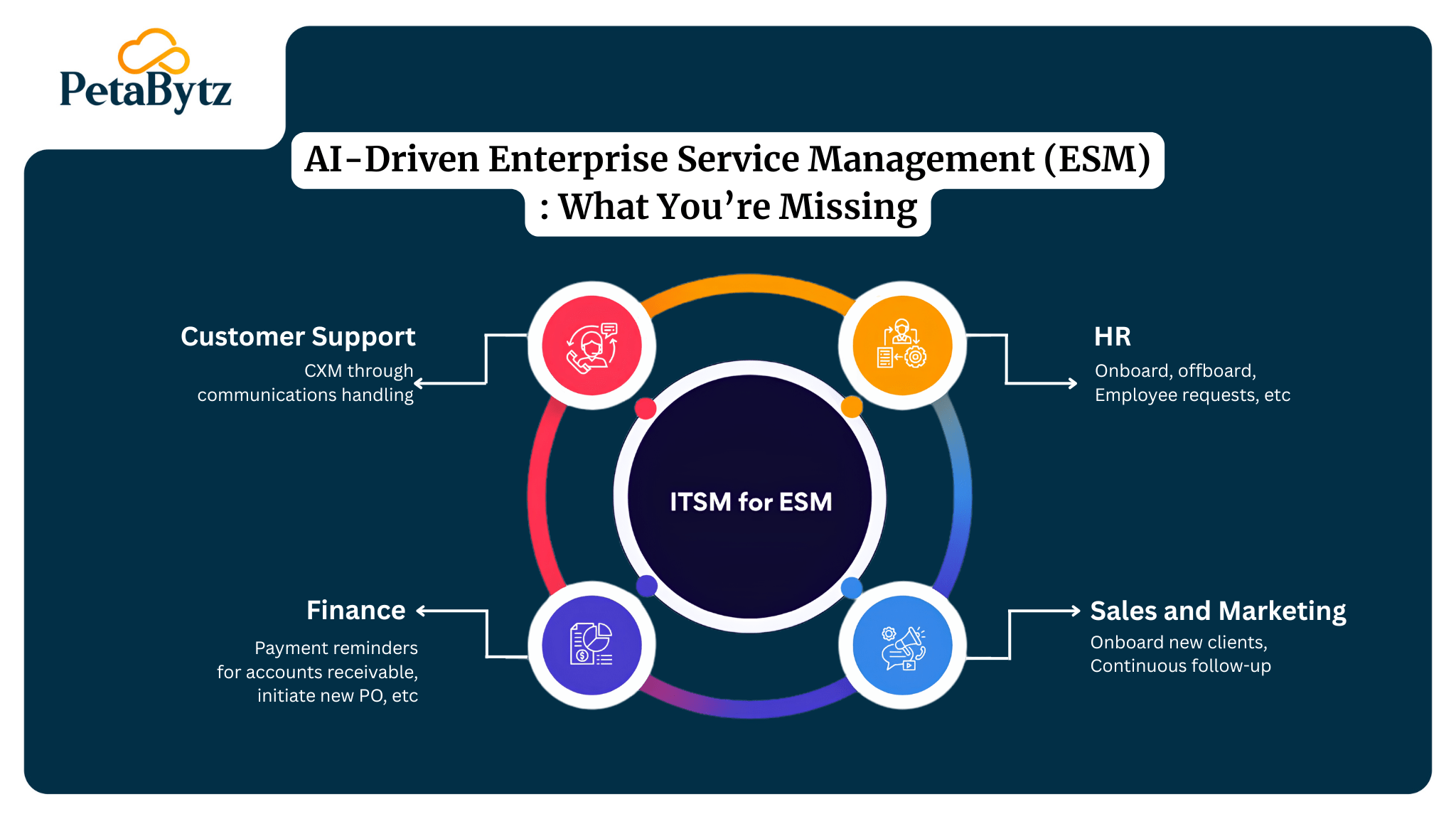
HR: From weeks to hours
HR runs on repetitive requests. Offer letters. Policy questions. Leave management. Benefits enrollment. Without enterprise service management, each request hits someone’s inbox and waits.
With AI-driven ESM, an employee asks a question – the AI searches the knowledge base, returns an accurate answer, and closes the ticket. No human needed. HR teams stop being a FAQ desk and start doing strategic work.
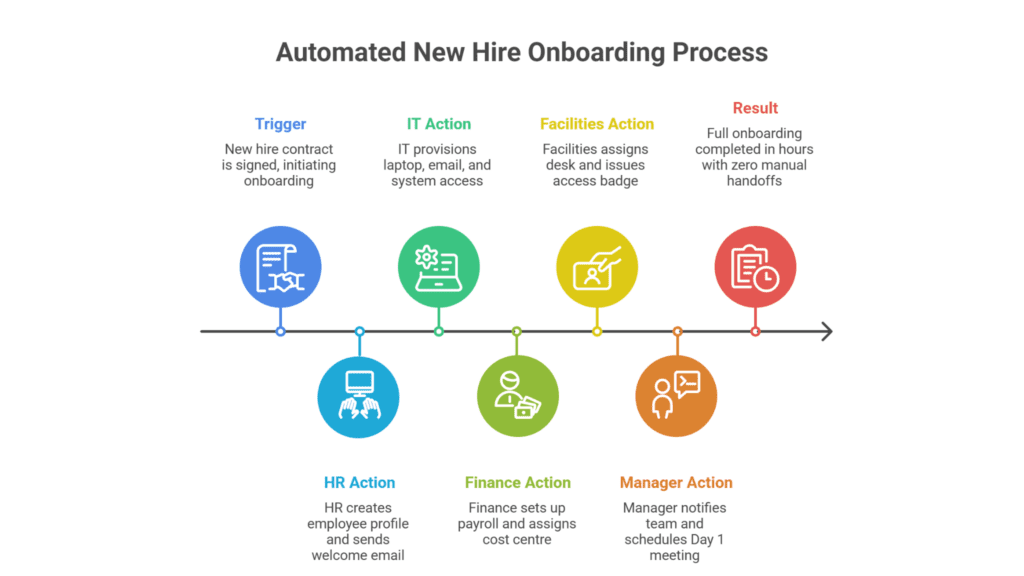
Onboarding and offboarding workflows run automatically across IT, Finance, and Facilities. The ESM system handles the orchestration. HR manages the exceptions.
Finance: Fewer delays, faster approvals
Finance teams lose hours chasing purchase order approvals, vendor payment confirmations, and expense escalations. These aren’t complex problems. They’re process problems.
AI-driven enterprise service management automates payment reminders for accounts receivable, routes PO requests to the right approver based on amount and category, and flags overdue invoices before they become cash flow problems.
IT: Smarter than your average service desk
IT is where enterprise service management started – and where AI makes the biggest immediate impact. AI deflects 40-60% of Tier 1 requests through self-service. It predicts incidents before they escalate. It auto-resolves known issues using knowledge articles.
Your enterprise service desk stops being a firefighting team. It becomes a strategic function.
Sales and marketing: Service thinking for revenue teams
Sales teams lose deals in the follow-up gap. Leads go cold. Onboarding stalls. Demo requests sit unassigned for days.
ESM applied to Sales and Marketing creates structured workflows for client onboarding, automated follow-up sequences, and transparent pipeline handoffs. AI tracks request age, sends reminders, and escalates when a deal is at risk.
Business impact and ROI of AI-driven enterprise service management
The numbers are not theoretical. Organizations that implement AI in their enterprise service management system see measurable outcomes – fast.
- 40–60% reduction in Tier 1 ticket volume through AI self-service
- 30–50% faster mean time to resolution (MTTR) across departments
- Up to 25% reduction in agent headcount requirement through automation
- Employee satisfaction scores improve when wait times drop and self-service works
- Cross-functional visibility means fewer SLA breaches and faster escalation
The ROI compounds. AI learns from every interaction. The more data your enterprise service management system processes, the smarter the routing, the more accurate the predictions, the faster the resolution.
Challenges and risks to watch for
AI-driven enterprise service management isn’t plug-and-play. Here are the risks that derail most implementations:
Poor data quality
AI is only as good as the data it trains on. If your ticket history is messy, your knowledge base is outdated, or your categorization is inconsistent – your AI will be too.
Adoption resistance
Agents fear replacement. Departments fear losing control. ESM rollouts die in the “change management” phase more often than the technical phase. Address the human side early.
Scope creep
Trying to automate everything at once kills momentum. Start with one high-volume, high-friction workflow. Prove ROI. Then expand. Enterprise service management works best when it grows organically from wins.
The future of AI in enterprise service management
ESM is moving toward autonomous service delivery. The next generation of enterprise service management software won’t just route tickets. It will resolve them independently.
Agentic AI is already here. AI agents that can read a request, pull data from multiple systems, take action across platforms, and close the loop – without a human approving each step.
Natural language interfaces will replace forms. Employees will describe what they need in plain language and the ESM system will figure out the rest – which department, which workflow, which approver, which SLA.
Predictive service management will shift the entire model from reactive to proactive. Your enterprise service desk will contact employees before they even know there’s a problem.
Organizations that start building AI-ESM capability now will have a significant operational advantage in 18 months. Those that wait will be playing catch-up.
How ITSM services connect this to your reality
Here’s the uncomfortable truth most vendors won’t say: most enterprise service management implementations are too complex, too expensive, and too slow for where you are right now.
You don’t need a 12-month ESM transformation program. You need the right workflows, the right AI integrations, and the right service desk foundation – deployed in a way that actually sticks.
That’s where Petabytz ITSM Services come in. The team focuses on cross-functional workflow orchestration, AI-assisted triage, and enterprise service management implementation that scales with your business – not against it.
Whether you’re running a legacy ITSM setup or building enterprise service management from scratch, the approach is practical: start with your highest-pain workflow, automate it intelligently, and measure the outcome before expanding.
Conclusion
You don’t need to overcomplicate this. Enterprise service management works when it’s built around real friction – not a consultant’s framework.
AI doesn’t replace the human judgment in your service operations. It removes the repetitive, low-value work that blocks your teams from applying that judgment where it matters.
Every department – HR, Finance, IT, Sales – has workflows that should be faster, smarter, and more connected. Enterprise service management is the model. AI is the engine.
You already know what’s broken. Now you know what fixes it.
Talk to Petabytz. Start with one workflow. See what AI-driven enterprise service management actually looks like in your environment.
Website: www.petabytz.com
Email: info@petabytz.com
Frequently Asked Questions (FAQ’s)
What is enterprise service management (ESM)?
Enterprise service management is the extension of ITSM principles ticketing, workflows, SLAs to non-IT departments like HR, Finance, and Operations. It creates a unified service model across the entire organization using a shared enterprise service management system.
How is ESM different from ITSM?
ITSM is focused exclusively on IT service delivery. Enterprise service management expands that framework across all business functions. ESM uses ITSM as a foundation, but the scope, stakeholders, and workflows are organization-wide, not just IT.
What does an enterprise service management system include?
A mature enterprise service management system typically includes a unified enterprise service desk, cross-departmental service catalogues, AI-powered triage and routing, knowledge management, SLA tracking, and workflow automation tools. AI integration is increasingly core - not optional.
What are the benefits of AI-driven enterprise service management?
AI-driven enterprise service management reduces ticket volume through intelligent self-service, speeds up resolution times with predictive routing, enables cross-functional workflow orchestration, and gives organizations real-time visibility into service performance across departments.
Recent Posts