INDIA
INDIA
 USA
USA CANADA
Agentic AI vs Generative AI vs RPA: The Evolution Beyond Automation
17/04/2026
You spent months deploying bots. They worked fine – until something changed. A form field shifted. A process got updated. And suddenly, your entire automation broke.
This is the silent frustration of teams that built their operations on rule-based automation. It works until it does not. And fixing it costs more than building it.
The shift happening right now is not just technical. It is strategic. We are moving from automating tasks to automating decisions – and the difference is enormous.
In this guide, you will learn:
- What RPA, Generative AI, and Agentic AI actually are (without the jargon)
- The core difference between agentic AI vs generative AI and why it matters
- How agentic AI vs RPA stacks up in real business scenarios
- Real-world agentic AI examples across industries
- How to build a practical adoption roadmap from RPA to agentic AI
Contact us now
Agentic AI vs Generative AI vs RPA | 2026 Guide
What is RPA, and why did we all fall in love with it?
Robotic Process Automation – or robotic process automation RPA software — was the first real answer to operational inefficiency. It gave businesses bots that could mimic human actions: clicking, copying, pasting, and processing data across systems.
It was fast to deploy, easy to understand, and delivered measurable ROI. Invoice processing, employee onboarding forms, data migration, RPA crushed repetitive, high-volume tasks. But here is the problem. RPA is purely rule-based. It does exactly what you tell it. No more, no less. The moment a UI changes, a new exception appears, or data comes in unstructured form, the bot fails. It has no intelligence. It cannot adapt. It just stops.
RPA gave us hands. Fast, reliable, tireless hands. But hands without a brain.
What is Generative AI, and where does it fall short?
Generative AI changed everything about content and productivity. Give it a prompt, and it creates — text, code, summaries, images, and entire email drafts. Tools built on gen AI agents like ChatGPT and Copilot became productivity multipliers overnight.
In support teams, Generative AI powered smarter chatbots. In development, it wrote boilerplate code. In marketing, it drafted campaigns in minutes. The efficiency gains were real. But Generative AI is fundamentally reactive. It waits for your input. It creates output. And then it stops. It does not take the next step on its own. It does not connect to your CRM, open a ticket, or trigger a workflow unless a human initiates it.
Generative AI gave us a brain. A capable, articulate brain. But one that still needed a human to act on its advice.
What is Agentic AI, and why is it different?
Agentic AI is the next step. It combines intelligence with execution. Instead of waiting for input, agentic AI systems are goal-driven. You give them an outcome. They plan the steps, make decisions, take actions, and learn from what happens.
The difference between AI agents and agentic AI matters here. AI agents are individual tools that perform specific tasks. Agentic AI refers to systems capable of orchestrating multiple agents toward a broader goal – what practitioners call agentic orchestration.
Think about IT support. A traditional chatbot asks for your issue. A Generative AI drafts a helpful reply. An agentic AI system detects the incident, diagnoses the root cause, pulls the relevant runbook, executes the fix, and closes the ticket — without a human in the loop.
That is not assistance. That is autonomous execution. Agentic AI does not just advise – it acts.
The evolution from RPA to Generative AI to Agentic AI
Think of it this way:
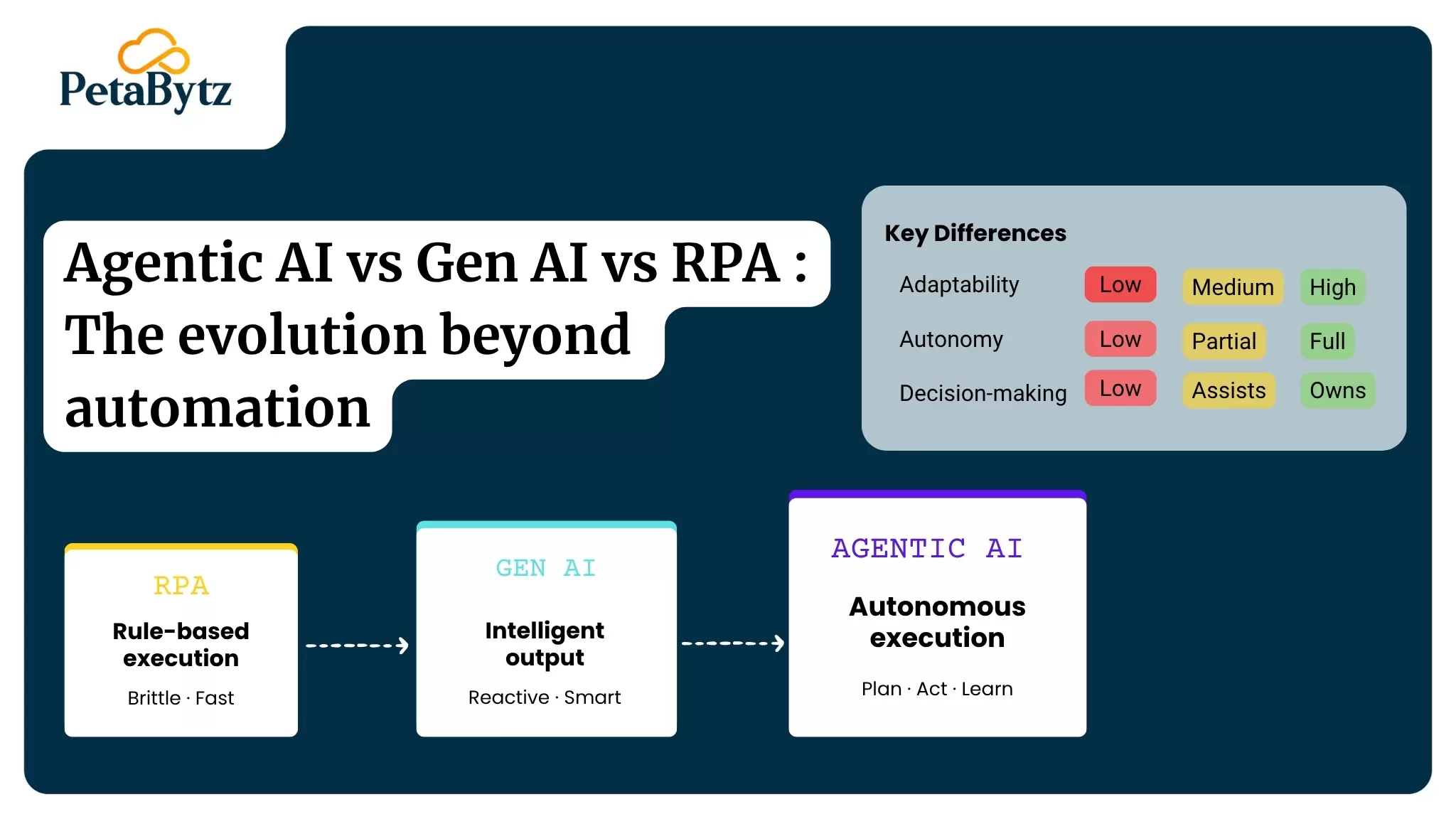
- RPA = Hands. Executes predefined steps on structured data. Fast, brittle, zero intelligence.
- Generative AI = Brain. Creates, suggests, and synthesizes. Powerful, but reactive and dependent on human prompts.
- Agentic AI = Brain and Hands. Plans, decides, acts, and improves. End-to-end autonomy with minimal human intervention.
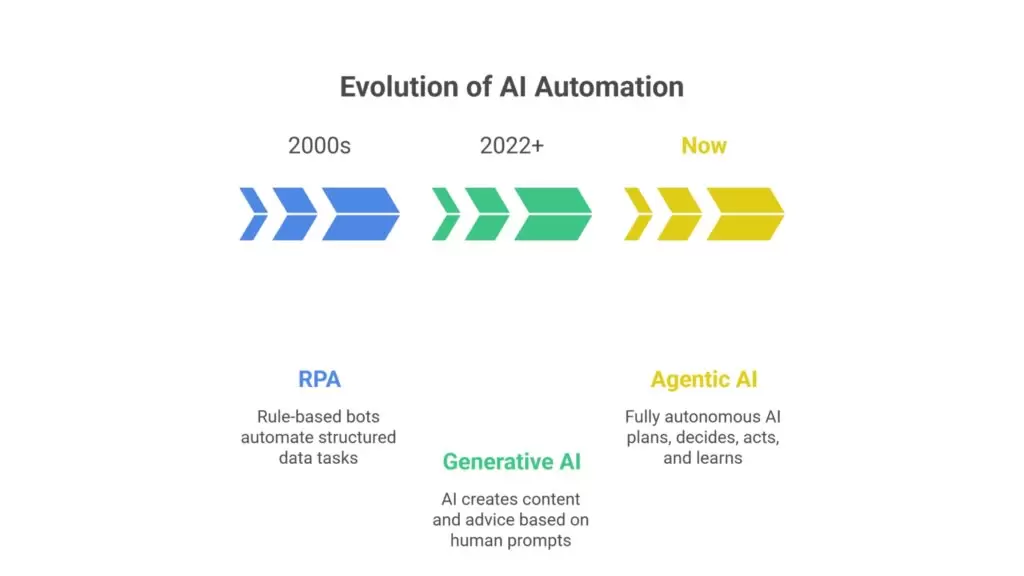
This is not a replacement story. It is an evolution. Many organizations are already running all three in parallel – RPA handling structured repetitive work, Generative AI assisting humans with content and analysis, and agentic AI systems managing entire workflows end-to-end.
The comparison of agentic AI vs generative AI vs RPA is not about which wins. It is about knowing when to use which – and how to layer them intelligently.
Real-world agentic AI examples across industries
IT service management
A global SaaS company integrated an agentic AI system into their ITSM platform. When an alert fires, the system automatically classifies the incident, checks historical patterns, selects the appropriate resolution script, executes it, and notifies stakeholders. Resolution time dropped from 45 minutes to under 4 minutes. No human had to be paged for routine incidents.
Customer support operations
A fintech startup moved from a rule-based chatbot to a system built on gen AI agents with agentic orchestration. The system can now verify identity, pull account history, process refund requests, escalate edge cases, and update the CRM – all within a single conversation. Customer satisfaction scores improved by 38% within three months.
Finance and accounts payable
An enterprise manufacturer started with RPA for invoice processing. They layered Generative AI to handle exception summaries and vendor communication. Then they introduced agentic AI to manage the full accounts payable cycle – matching, approvals, flagging anomalies, and triggering payments – with a human only reviewing outliers. Processing costs fell by 60%.
Challenges and risks you should not ignore
Agentic AI is not a plug-and-play solution. Every team that rushes implementation without governance pays for it.
- Governance gaps: Agentic systems make decisions. Without clear guardrails and audit trails, accountability breaks down fast.
- Security exposure: Autonomous agents that can access systems and execute actions are a larger attack surface. Every integration is a potential vulnerability.
- Over-automation risk: Not every workflow should be fully autonomous. Knowing where to keep humans in the loop is a strategic decision, not a technical one.
- Loss of control: As systems become more autonomous, visibility into what they are actually doing becomes harder. Observability tools are non-negotiable.
Start with a limited scope. Instrument everything. Build trust in the system gradually before expanding autonomy.
How businesses should actually adopt this – a practical roadmap
You do not need to overhaul everything at once. The most successful teams build toward agentic AI in clear stages.
- Start with RPA for high-volume structured tasks. Invoice processing, data entry, report generation. Build operational confidence and ROI.
- Layer in Generative AI for intelligence augmentation. Add gen AI agents to handle unstructured inputs, draft communications, summarize data, and support decision-making.
- Identify workflows ready for agentic orchestration. Look for end-to-end processes where the decision logic is clear, the stakes are manageable, and the value of full automation is high.
- Instrument, govern, and iterate. Build observability in from day one. Set escalation thresholds. Let the system earn expanded autonomy over time.
Organizations that adopt agentic AI early will not just be more efficient – they will be structurally different from their competitors. The gap between agentic AI vs RPA is not a technology gap. It is a business model gap.
If you are evaluating where to begin, Petabytz Technologies offers agentic AI services designed to help enterprises move through this roadmap without the common pitfalls – from architecture to deployment to governance. The focus is on measurable outcomes, not just implementation.
Conclusion
RPA solved yesterday’s efficiency problem. Generative AI is solving today’s productivity problem. Agentic AI is solving tomorrow’s autonomy problem.
The evolution from robotic process automation RPA software to gen AI agents to fully agentic systems is not a distant future scenario. It is happening in enterprise IT, finance, support, and operations right now. You do not need to overcomplicate it. Start where you are. Add intelligence where it creates leverage. Move toward autonomy where trust is earned.
The question is no longer if you adopt agentic AI. It is how fast.
Frequently Asked Questions (FAQ’s)
What is the difference between AI agents and agentic AI?
AI agents are individual tools designed to perform specific tasks. Agentic AI refers to a broader system that orchestrates multiple agents to achieve a complex, multi-step goal with minimal human intervention. Agentic AI coordinates; AI agents execute.
What is agentic AI vs RPA in practical terms?
RPA follows fixed rules on structured data and breaks when things change. Agentic AI adapts, makes decisions, and handles unstructured inputs. RPA is a tool for repetition; agentic AI is a system for reasoning and execution.
Can agentic AI replace generative AI?
No — and it should not. Generative AI excels at content creation, summarization, and human-assisted tasks. Agentic AI builds on that foundation by adding autonomous action. Most mature deployments use both together as part of an agentic orchestration architecture.
What are some good agentic AI examples for enterprises?
Strong agentic AI examples include autonomous IT incident resolution, end-to-end accounts payable workflows, AI-driven customer support with CRM integration, and supply chain monitoring agents that detect anomalies and trigger corrective actions automatically.
Recent Posts