INDIA
INDIA
 USA
USA CANADA
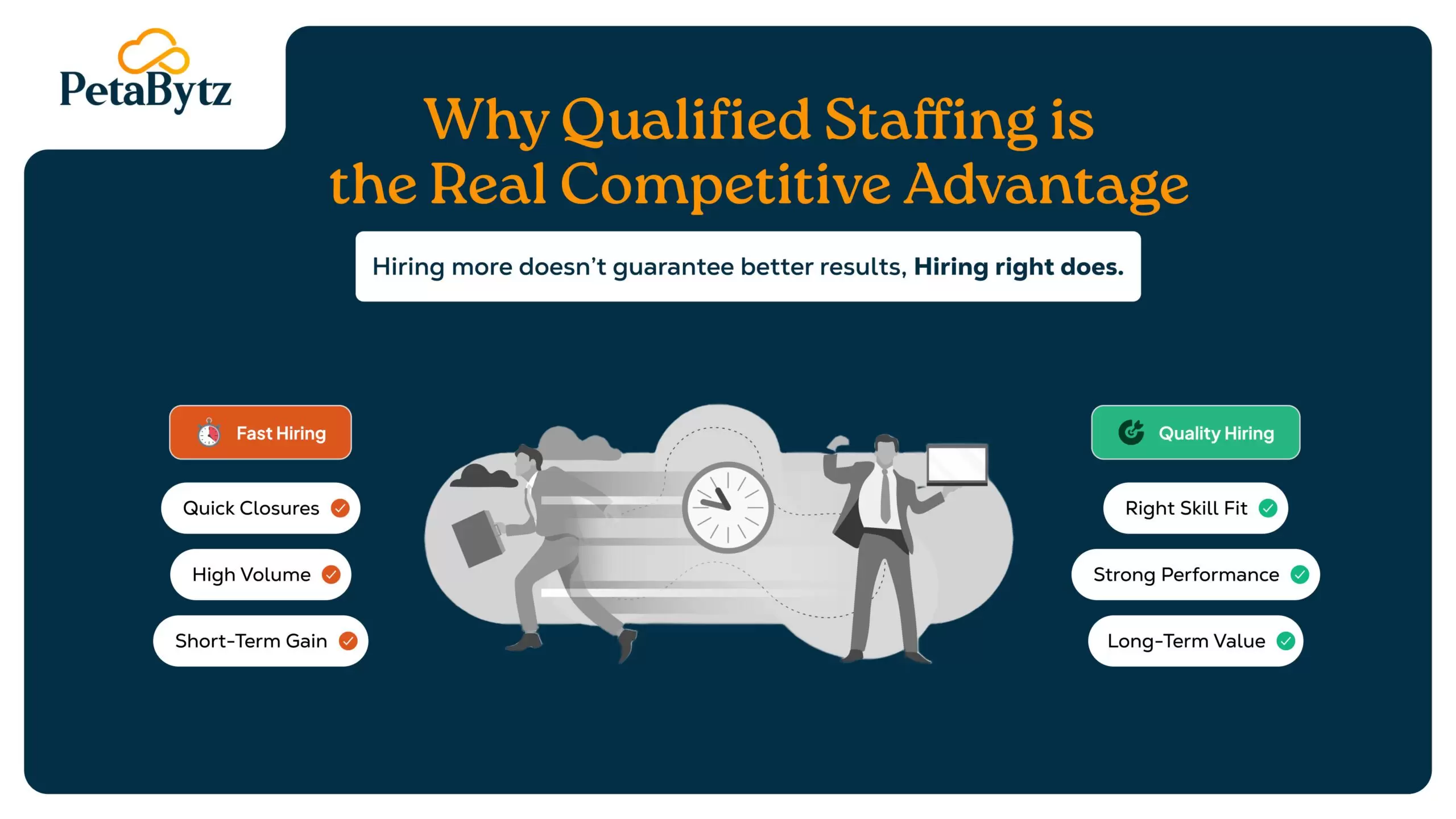
Why qualified staffing is the real competitive advantage?
17/04/2026
You filled the role in two weeks. Everyone applauded the speed. Then, six months later, the person quietly stopped delivering. Deadlines slipped. The team compensated. You eventually had to restart the process — only this time with a damaged project and a frustrated team.
This is what happens when hiring speed becomes the only metric that matters.
The organizations consistently outperforming their competition are not the ones hiring fastest. They are the ones hiring best. And that starts with a commitment to qualified staffing.
In this guide, you will learn:
- What qualified staffing actually means in practice
- Why quality hiring is now a strategic business function
- When to apply structured quality staffing approaches
- The core elements that make quality staffing services work
- Real templates, examples, and best practices you can apply immediately
Contact us now
Why Qualified Staffing Drives Real Business Growth
What is qualified staffing?
Qualified staffing is the process of identifying, screening, and placing candidates who are genuinely suited for a specific role — not just technically capable, but aligned with the team, the culture, and the business goals.
It is different from standard recruitment in one important way: it is outcome-driven. The goal is not to fill a seat. The goal is to place someone who performs, stays, and contributes over time.
Quality staffing services use structured assessments, intelligent screening, and role-fit validation to ensure every hire is a deliberate decision — not a hopeful guess.
Why qualified staffing matters in 2026
The market has changed. Talent is harder to find, harder to retain, and more expensive to replace. Speed-hiring strategies that worked in a surplus talent market are now creating attrition problems and performance gaps.
Here is what organizations gain when they prioritize quality staffing:
- Better performance from day one. Role-aligned hires ramp up faster and need less handholding.
- Lower attrition. People who fit the role and culture stay longer, reducing replacement costs.
- Stronger team dynamics. One right hire elevates the whole team. One wrong hire drags it down.
- Reduced cost-per-hire over time. Quality staffing services reduce the cycle of rehiring, retraining, and re-onboarding.
- Faster long-term growth. The right people execute faster, think better, and build stronger momentum.
A bad hire at the mid-level costs an organization anywhere from 30% to 150% of that person’s annual salary when you factor in lost productivity, rehiring, and team disruption. Quality staffing prevents that entirely.
When should you use qualified staffing?
Not every hiring scenario requires the same approach. But these are the moments where qualified staffing becomes non-negotiable.
When scaling a technical team quickly
IT staff augmentation is one of the most common use cases. When you need to expand your engineering or technology team fast, quality staffing services ensure you are not just adding headcount – you are adding capability. IT staff augmentation services give you access to pre-vetted, role-ready professionals who integrate smoothly into existing workflows.
When a key position keeps turning over
If you have rehired for the same role two or three times, the issue is rarely the candidates. It is usually a broken screening process. Qualified staffing addresses root-cause misalignment, role clarity, culture fit, and expectation gaps – before the offer goes out.
When entering a new market or launching a product
New initiatives demand people who are not just experienced but adaptable. Staff augmentation services allow organizations to bring in specialized talent for specific phases without long-term overhead.
When business growth has outpaced your internal HR capacity
Internal HR teams are often stretched during growth phases. Quality staffing services step in as an extension of your team – handling sourcing, screening, and candidate validation so your team focuses on decisions, not logistics.
When building specialized or niche capability
For roles in data science, cloud engineering, cybersecurity, or AI development, generic job boards rarely surface the right candidates. Qualified staffing through IT staff augmentation channels reaches passive, specialized talent who would not apply through standard pipelines.
Key elements of effective quality staffing services
Not all staffing approaches are equal. Here is what separates structured quality staffing from transactional recruitment.
1. Role clarity before sourcing
Every qualified staffing engagement should begin with a deep role analysis. This means understanding not just the job description but the performance outcomes expected in the first 90 days. Without clarity here, even the best screening process surfaces the wrong candidates.
2. Structured, multi-layer screening
Quality staffing services use layered screening — skills validation, behavioral assessment, cultural alignment checks, and reference verification. Each layer filters out candidates who look good on paper but would not perform in the actual environment.
3. Culture and team fit validation
Skills can be trained. Attitude and cultural alignment largely cannot. The best quality staffing processes include structured conversations around collaboration style, feedback tolerance, and work ethic — not just technical competencies.
4. Candidate calibration with the hiring manager
Quality staffing is collaborative. Staffing partners who calibrate with hiring managers after each shortlist round — gathering feedback on what is landing and what is not — narrow down candidates faster and with fewer wasted interviews.
5. Post-placement tracking and performance check-ins
The best quality staffing services do not disappear after the offer letter. They track placement success at 30, 60, and 90 days — catching integration issues early and ensuring the hire is delivering as expected.
6. Transparent, data-informed sourcing
Quality staffing should be measurable. Time-to-fill, quality-of-hire scores, offer acceptance rates, and 90-day retention rates are all signals of whether your staffing approach is working. If your staffing partner cannot show you these numbers, that is a problem.
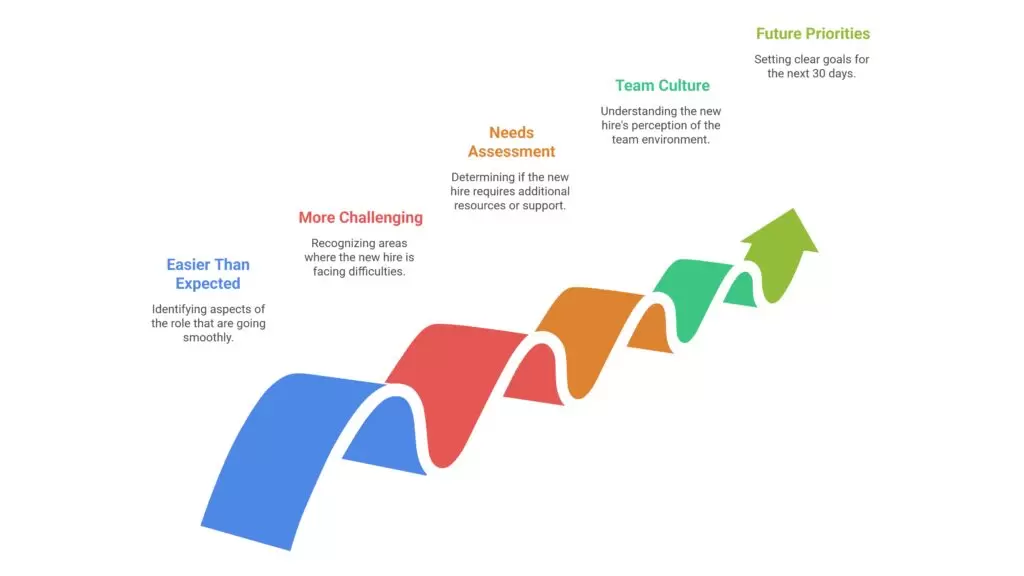
Post-placement 30-day check-in script
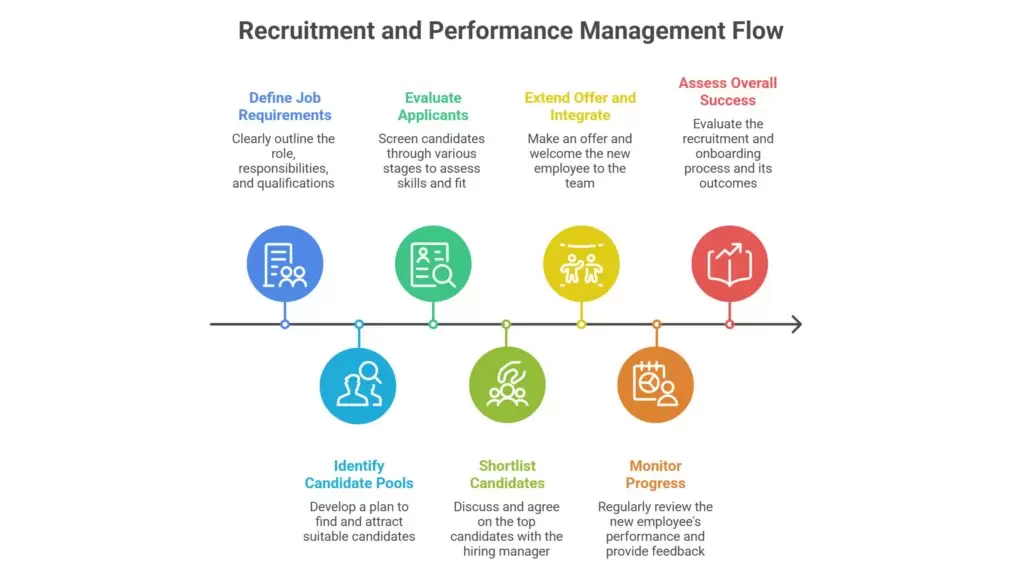
Qualified staffing workflow overview
Real examples of quality staffing done right
Example 1: SaaS company rebuilds engineering bench through IT staff augmentation
A mid-sized SaaS company had experienced 40% attrition in its backend team over 18 months. Every new hire left within a year. Rather than continuing with the same job board approach, they engaged an IT staff augmentation provider who conducted a role alignment audit first. They discovered the job description had been attracting senior engineers for what was effectively a mid-level execution role. The provider re-scoped the role, re-targeted sourcing, and placed three candidates within 60 days. All three were still with the company two years later.
This works because quality staffing addressed the root cause — role misalignment — rather than just filling the seat again.
Example 2: Fintech startup scales without culture dilution
A 50-person fintech startup needed to double its headcount in nine months ahead of a Series B close. Their concern was not just skills — it was protecting a culture that had been carefully built. They worked with a quality staffing service that embedded cultural fit scoring into every candidate presentation. Of the 47 people hired in that period, the 12-month retention rate was 91% — compared to an industry average of 68%.
This works because: making culture alignment a formal screening criterion turns it from a gut feeling into a measurable outcome.
Example 3: Enterprise IT team fills niche cloud roles via staff augmentation services
A logistics enterprise needed three AWS solution architects for a cloud migration initiative. Their internal HR team had been searching for two months with no qualified candidates. They turned to IT staff augmentation services, which tapped a specialized passive talent network and presented five pre-screened candidates within three weeks. The project launched on schedule and under budget.
This works because: specialized qualified staffing reaches talent pools that standard job postings cannot access.
Example 4: Regional firm eliminates repeat hiring cycle for sales leadership
A regional professional services firm had hired and lost four sales directors in three years. A quality staffing engagement began with a structured debrief of all four departures. The pattern was consistent — candidates came in expecting a mature sales infrastructure that did not exist. The fifth placement included pre-hire expectation alignment sessions. That hire stayed for four years and grew revenue by 38%.
This works because: qualified staffing includes expectation alignment, not just skills matching.
Best practices to improve your quality staffing outcomes
- Define success before you source. Know what a successful hire looks like at 90 days, 6 months, and 1 year before you write the job description. This shapes every downstream decision in the qualified staffing process.
- Involve the team, not just the manager. The people a new hire works alongside daily are the ones who will signal fit or friction fastest. Including one or two team members in the interview panel improves quality hiring accuracy significantly.
- Use structured interviews consistently. Unstructured interviews are the most common reason for bad quality hires. Every interviewer should ask the same core questions. Every evaluation should use the same scorecard. Quality staffing services formalize this — your internal process should too.
- Track quality-of-hire, not just time-to-fill. Speed is easy to measure. Quality is harder but more important. Track 90-day performance ratings, 1-year retention, and manager satisfaction with each placement as part of your qualified staffing metrics.
- Choose staffing partners who specialize. A generalist recruiter placing IT roles and a specialist IT staff augmentation provider are not the same. Specialization translates directly to better candidate quality, faster sourcing, and deeper market knowledge.
- Do not confuse urgency with compromise. The most expensive mistake in quality hiring is approving a borderline candidate because the role has been open for too long. A bad hire takes longer to fix than waiting two more weeks for the right one.
How the right staffing partner makes this easier
Most organizations know they need to hire better. The challenge is that quality staffing requires structure, specialization, and time — three things internal teams rarely have enough of during growth phases.
This is where a dedicated staffing partner changes the equation. Rather than reactive hiring, they build a qualified staffing pipeline aligned to your business roadmap. Rather than generic candidate pools, they target passive, pre-assessed talent matched to your specific role criteria.
At Petabytz Technologies, the RWAS (Right Work, Right Talent, At Scale) staffing model is built around exactly this. It combines intelligent screening, role-fit validation, and structured IT staff augmentation services to ensure organizations are not just filling roles — they are building performing teams.
The goal is not quick closures. It is long-term outcomes. And the difference between those two things shows up clearly in team performance, retention, and business momentum over time.
Conclusion
You do not need to overcomplicate quality hiring. You need to be intentional about it.
Every strong team is built one right hire at a time. And every right hire starts with a clear process — role clarity, structured screening, culture alignment, and honest calibration.
Qualified staffing is not a luxury for large enterprises. It is a decision available to any organization that chooses to treat hiring as a strategic function rather than an operational task.
The organizations winning right now are not the ones with the biggest hiring budgets. They are the ones making the smartest hiring decisions. And you can do the same — starting with the next role you open.
Frequently Asked Questions (FAQ’s)
What is the difference between qualified staffing and regular recruitment?
Regular recruitment focuses on filling open roles. Qualified staffing focuses on long-term fit — screening for skills, culture, and role alignment to ensure the hire performs and stays. Quality staffing reduces attrition, rehiring costs, and team disruption.
How does IT staff augmentation support quality hiring?
IT staff augmentation gives organizations access to pre-vetted technical talent without long-term overhead. For specialized roles in engineering, cloud, and data, IT staff augmentation services reach passive talent that standard job boards cannot, while maintaining a qualified staffing standard throughout.
How do I measure the quality of a hire?
Track 90-day performance ratings from the direct manager, 6-month team feedback scores, 1-year retention, and whether the hire met their initial role objectives. These signals together define qualified staffing success far better than time-to-fill alone.
When should a company use staff augmentation services vs. full-time hiring?
Use staff augmentation services when you need specialized talent for a defined period, or when scaling a team faster than internal hiring capacity allows. Use full-time qualified staffing when the role is core to long-term strategy and requires deep institutional knowledge over time.
Recent Posts