What is staff augmentation?
Staff augmentation is a flexible hiring model where you bring in external tech professionals to work within your existing team – on your tools, your timelines, and under your direction.
It is not outsourcing. You are not handing off a project and waiting for deliverables. The augmented engineer sits inside your team, attends your standups, and reports to your lead.
IT staff augmentation gives you the speed of a contractor with the integration of a full-time hire. You control the work. The augmentation partner handles the sourcing, vetting, and compliance.
Think of it as renting capacity – not just a body, but a screened, relevant, ready-to-contribute professional.
Why staff augmentation matters in 2026
The hiring environment has changed permanently. IT teams are expected to ship faster, reduce costs, and handle spikes in scope — often all at the same time.
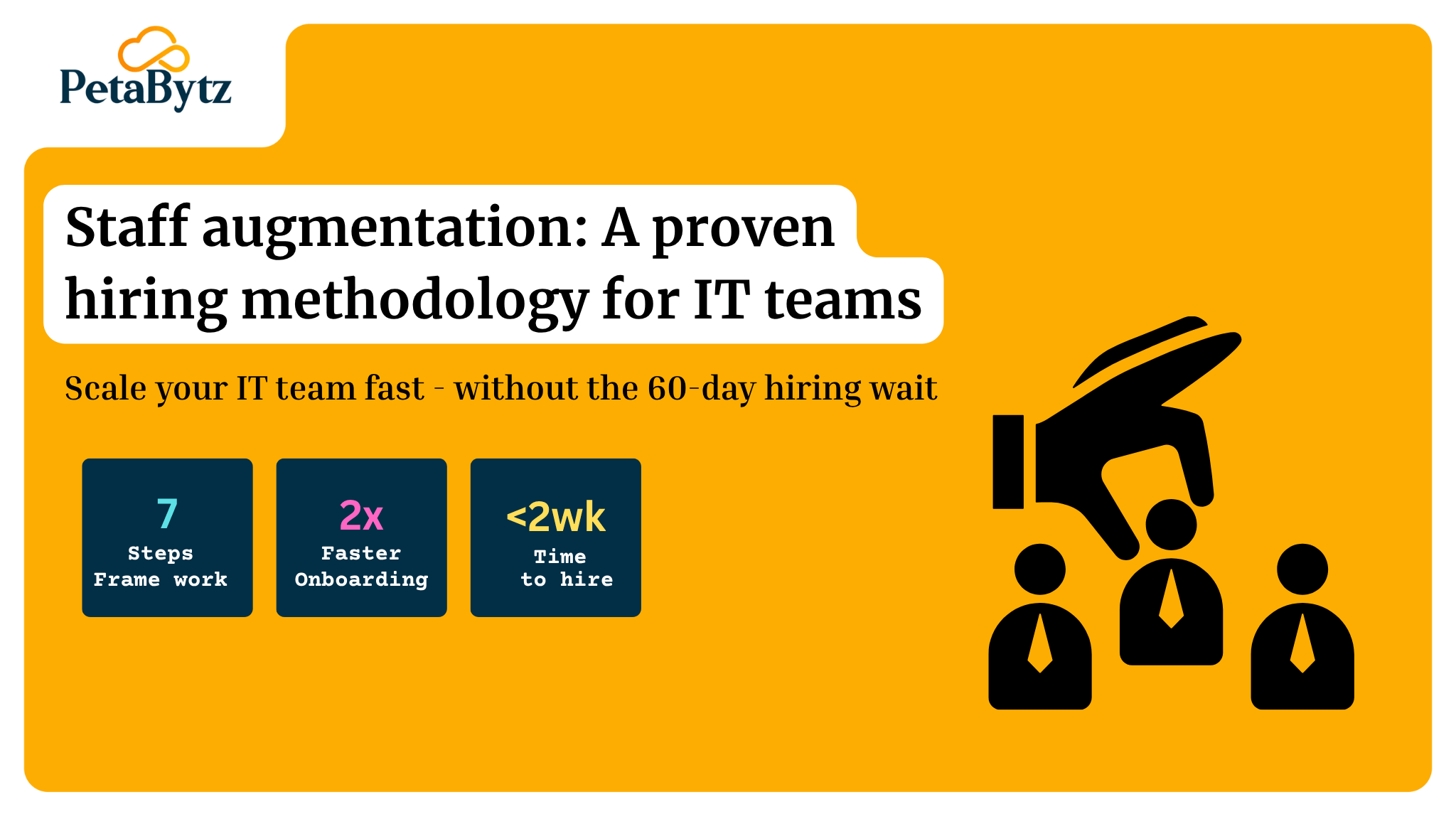
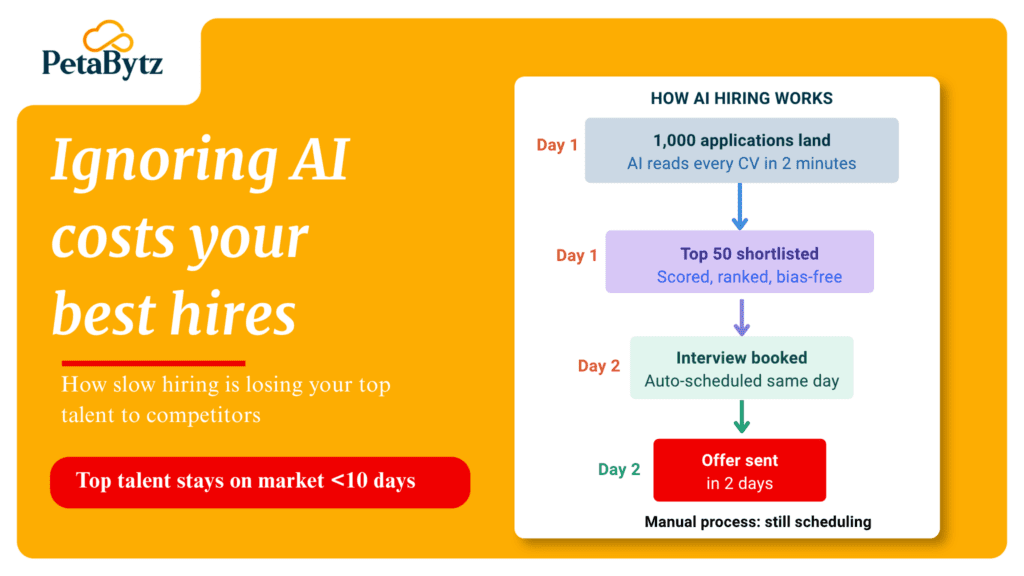
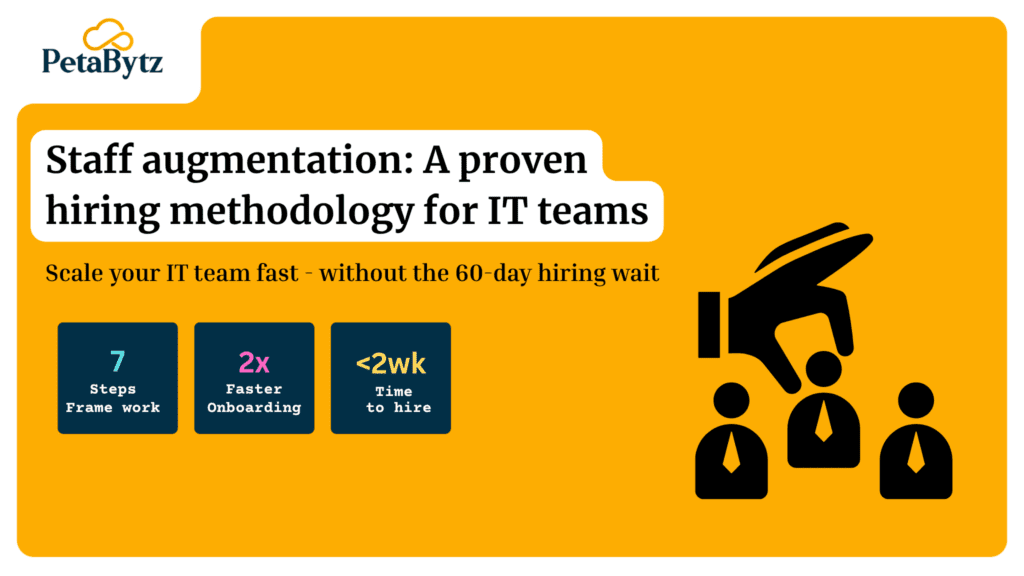
Traditional full-time hiring takes 45 to 90 days on average. By the time you onboard someone, the sprint has passed. Staff augmentation services cut that timeline dramatically — often to under two weeks.
Here is why engineering leaders are turning to resource augmentation services:
- Speed to productivity: Augmented professionals are already vetted and need minimal ramp-up time.
- Cost control: No payroll taxes, benefits overhead, or severance costs. You pay for the time you need.
- Access to niche skills: Need a Rust developer or a DevSecOps engineer for one quarter? Staff augmentation makes it possible without a permanent commitment.
- Team integration: Unlike outsourcing, augmented staff adopt your culture, tools, and cadence.
- Reduced hiring risk: You can evaluate fit before converting to a permanent role.
When should you use staff augmentation?
IT staff augmentation is not the answer to every hiring situation. But there are specific moments where it is clearly the right move.
You have a project deadline and a headcount gap
A client just moved the launch date. You need two senior backend engineers in the next ten days. You cannot wait for a 60-day hiring process. Staff augmentation fills that gap fast — without burning out your existing team.
You need a skill your team does not have
Your product roadmap just added AI/ML features. Your current team has zero ML experience. Hiring a permanent ML engineer for a six-month scope makes no financial sense. Augmenting with a specialist does.
You are scaling fast and headcount approvals are slow
Enterprise procurement and HR approval cycles can take months. IT staff augmentation companies let you add capacity while the paperwork catches up. It keeps delivery moving without violating budget policies.
You want to test before you commit
Staff augmentation doubles as a trial period. You work with the engineer for three months. If the fit is excellent, you convert. If it is not, you simply end the engagement. No severance, no HR complexity.
You are entering a new market or technology domain
Expanding into cloud migration, cybersecurity, or a new geography? Augmenting with professionals who have done it before gets you further, faster. You gain domain knowledge without a permanent overhead cost.
The 7-step staff augmentation hiring methodology
Most IT staff augmentation companies hand you a shortlist and call it a process. That is not a methodology. A real methodology is structured, repeatable, and designed to reduce both time-to-hire and mis-hire risk.
Here is the seven-step framework we use at Petabytz:
Step 1: requirement discovery and role calibration
Before sourcing a single resume, we invest time in understanding what you actually need – not just the job description.
This means understanding the team structure, the engineering culture, the tech stack, the sprint cadence, and the success metrics for the role. Most mismatches happen here — when the role is not calibrated properly from the start.
We also help you decide between a contractor, a part-time augmentation, or a full-time augmented hire. The right model changes based on duration, scope, and integration depth.
Step 2: market mapping and talent intelligence
We do not just search job boards. We map the talent market for your specific role — compensation benchmarks, skill availability by geography, competing offers, and realistic timelines.
This intelligence helps you set the right offer range and avoid losing candidates to a competitor who moved faster. It also tells us whether to focus sourcing locally, remotely, or across specific talent markets.
Talent intelligence is what separates resource augmentation services that close roles from those that just fill your inbox with profiles.
Step 3: active and passive talent sourcing
Active candidates are the ones already applying. Passive candidates are the ones you want — employed, performing well, and not actively looking.
We run multi-channel sourcing: LinkedIn outreach, GitHub profiles, internal talent networks, referrals, and community-specific platforms for niche roles. For IT staff augmentation, passive sourcing often surfaces better candidates faster.
Sourcing is not spray-and-pray. Every outreach is personalized to the role and the candidate’s background. Response rates are higher. Time to first qualified profile drops significantly.
Step 4: technical and behavioral screening
A resume tells you what someone has done. Screening tells you whether they can actually do it — and whether they will work well with your team.
Technical screening is customized to your stack. We do not run a generic coding test. We assess for the specific languages, frameworks, architecture patterns, and problem-solving approach your role requires.
Behavioral screening covers communication style, autonomy, conflict handling, and cultural alignment. For staff augmentation, this matters enormously — augmented engineers need to integrate quickly with minimal hand-holding.
Step 5: curated shortlisting — 2 to 4 high-quality profiles
We do not send you fifteen profiles and ask you to sort it out. We send you two to four. Each one has cleared both technical and behavioral screening.
Every shortlisted profile comes with a structured summary: technical fit score, behavioral notes, availability, current CTC, expected CTC, and our recommendation on why this person works for the role.
Less volume. More signal. Your hiring manager spends less time reviewing and more time making a confident decision.
Step 6: interview coordination and offer management
A great candidate has options. The fastest offer wins — not always the highest one.
We coordinate every interview round — scheduling, reminders, feedback collection, and managing candidate expectations throughout. We also handle offer negotiation to keep the process from falling apart at the last step.
Offer drop-off is one of the most expensive moments in staff augmentation. We stay engaged through offer acceptance and Day 1 onboarding to protect that investment.
Step 7: post-joining follow-up and retention support
Most IT staff augmentation companies disappear after the engineer joins. We do not.
We check in at Day 7, Day 30, and Day 90. We track integration quality, flag early friction, and work with both sides to resolve issues before they become exits.
Retention is part of the service. A placement that leaves in month two is not a placement — it is a disruption. Our post-joining support dramatically reduces early attrition across engagements.
Best practices to get the most from staff augmentation
1. Calibrate the role before briefing your partner
Vague requirements produce poor profiles. Before you brief any IT staff augmentation company, spend 30 minutes answering these questions: What does this person build in Week 1? What does success look like at Day 90? What is the one non-negotiable technical skill?
2. Treat augmented engineers like team members, not contractors
The single biggest factor in augmentation success is integration. Include augmented staff in sprint planning, retrospectives, and team channels. Engineers who feel included perform better and stay longer.
3. Define success metrics from Day 1
What does a successful engagement look like? Define it in writing before the engineer joins. Velocity targets, code quality expectations, communication norms — all of it. Ambiguity kills augmentation engagements.
4. Choose staff augmentation companies in USA or globally based on your actual need
Not every role needs a local hire. Timezone overlap, communication fluency, and technical fit matter more than geography for most IT roles. If you are based in the US, look at staff augmentation companies in USA with proven remote engineering tracks — but also evaluate global partners where talent quality is high and timelines are faster.
5. Do post-joining check-ins at fixed intervals
Day 7, Day 30, and Day 90 are the three critical checkpoints. Early friction is almost always solvable if caught fast. If your augmentation partner does not proactively schedule these, build them into your own onboarding process.
6. Evaluate conversion readiness at the 60-day mark
If the augmented engineer is performing well and the engagement is open-ended, start the permanent conversion conversation at 60 days. Waiting until 90 days risks losing them to another offer. The best talent does not wait.
How Petabytz helps with IT staff augmentation
If you have made it this far, you already know that staff augmentation works when the process behind it is rigorous.
Most IT teams do not fail at staff augmentation because the model is wrong. They fail because the partner they chose was running a resume-forwarding operation, not a structured hiring methodology.
At Petabytz, our staff augmentation services are built around the 7-step framework above. We start with a deep-dive calibration call – not a generic intake form. We source actively and passively across tech-specific channels. We send 2 to 4 vetted profiles, not 15 unscreened ones. And we stay engaged post-joining to protect the fit you worked to find.
Whether you need a single senior engineer for a sprint crunch or want to scale a 10-person distributed team over the next quarter, our resource augmentation services are designed to move fast without cutting corners.
Website: www.petabytz.com
Email: info@petabytz.com
Conclusion
You do not need to overcomplicate staff augmentation. At its core, it is a simple idea: bring in the right skilled professional, integrate them into your team, and get things moving.
What makes it work is the methodology behind it. Requirement clarity. Market intelligence. Targeted sourcing. Real screening. Curated shortlisting. Fast offer management. Post-joining support. Each step reduces friction and de-risks the engagement.
IT teams that use staff augmentation strategically – not just as a last resort – outpace competitors on delivery speed, reduce hiring overhead, and access talent they could never attract through traditional full-time roles alone.
The model is not new. But the discipline behind it is rare. Now you have the framework. Use it.
Frequently Asked Questions (FAQ’s)
 INDIA
INDIA
 USA
USA CANADA